
Table of Contents
Low-dose edibles are cannabis edibles with a small amount of THC per piece — most often 1 to 5 mg, with 2.5 mg as the starting reference. They are made for beginners and for anyone who wants a light, manageable effect. The point is to start low, wait two hours, and only then decide whether you want more.
What Counts as a Low Dose?
There is no single legal definition of a low dose, but the numbers people use are fairly consistent. Most guides describe a microdose as roughly 1 to 5 mg of THC, and Health Canada’s guidance tells people new to edibles to look for products with 2.5 mg of THC or less. You can read that guidance on the Health Canada “lower your risks” page.
For context, a standard serving in many US markets is 10 mg of THC per piece. So a 2.5 mg piece is a quarter of a standard serving — a genuinely small amount, meant to sit below the point where most people feel overwhelmed, while still being enough to notice.
Two bands come up again and again in dosing guides. The 1 to 2.5 mg band is the ultra-low starting point, usually suggested for complete beginners, people who are sensitive to cannabis, or anyone who gets anxious easily. The 2.5 to 5 mg band is where many regular low-dose users settle once they know how their body responds. Both are reported ranges from public-health guidance — not a prescription, and not a promise about how you will feel.
The Ontario Cannabis Store notes that Health Canada treats 2.5 mg as a standard THC dose for edibles — a reference point, like a serving size on a nutrition label, not a recommended amount for everyone.
Why Start Low?
Edibles are slow, and slow is what gets people into trouble. The CDC notes that edible cannabis can take 30 minutes to 2 hours to be felt, and that the delay is exactly why some people take too much — they feel nothing after an hour, assume it did not work, and eat another one. You can read the CDC’s warning on its cannabis poisoning page.
Health Canada adds that it can take up to 4 hours to feel the full effects of an edible, and that effects can last up to 12 hours. Starting low does not remove that window, but it shrinks what is at stake inside it. A 2.5 mg piece that turns out stronger than expected is a very different afternoon from a 10 mg piece that does.
There is also a second reason: learning. Your first few sessions are about finding out how your body responds to a known amount, in a known setting, on a known day. Change one thing at a time and you learn something useful. Change all three at once and you learn nothing.
How to Choose a Low-Dose Product
A low-dose product is only low-dose if the label says so clearly, so start with the label, not the flavor or the packaging.
First, check the milligrams per piece, not just the total in the package. A bag that says 50 mg total might hold twenty 2.5 mg pieces or five 10 mg pieces — very different products. The number that matters is the one per piece. If the label does not state THC per piece clearly, put it back.
Second, look for a lab report, or certificate of analysis, that matches the batch number on your package. Our THC dosage chart walks through how dose bands are usually described. Labelling is not always accurate, and the CDC flags inaccurate potency labelling as one of the risks with edibles, so a product with a matching, recent lab report is a better bet than one without.
Third, think about format. Gummies, mints, and chocolates made at 2.5 mg or 5 mg per piece are the easiest way to microdose, because each piece is the same dose and there is no cutting or guessing. Drinks and baked goods are harder to split evenly, and homemade edibles are the hardest of all to dose precisely. For a first session, a factory-made 2.5 mg piece beats a carefully cut corner of a brownie.
Fourth, consider a balanced THC-to-CBD product. Health Canada suggests choosing products with a low amount of THC and an equal or higher amount of CBD, and a 1:1 piece often feels steadier for beginners than THC alone. That is not a guarantee, and CBD does not cancel THC, but it tilts the odds toward a gentler first session.
Finally, buy from a licensed, regulated source where that is available to you, and check the rules where you live first. Laws on edibles vary widely. This guide is general information, not legal advice, and it is written as of November 2026.
A Slow First Session, Step by Step
These are reported habits from public-health guidance and dosing guides, not instructions from a doctor. Talk to your doctor first if you take other medications or have a health condition.
- Pick a free evening at home. Choose a day with nothing you have to do for the next several hours, ideally with a trusted person nearby who knows what you took.
- Eat a normal meal first. Taking an edible on a completely empty stomach can make the onset feel sharper and less predictable, while a very heavy meal can slow it down further. A regular meal is the middle ground.
- Take one 2.5 mg piece — and stop. That is the whole dose for this session. Do not take a second piece “just in case,” or top up with a different product.
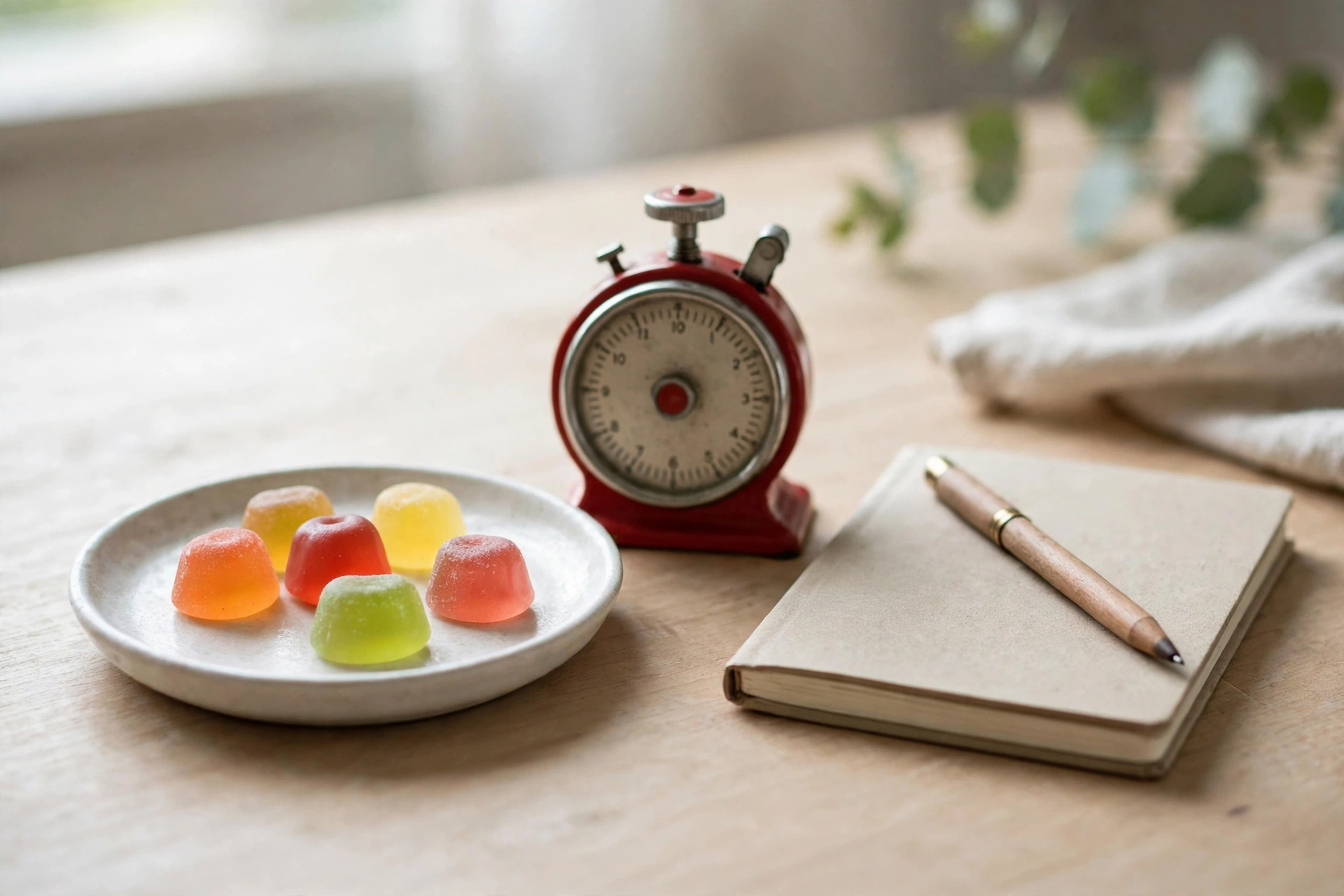
- Wait at least two hours before deciding anything. Set a timer. The CDC’s onset window runs to two hours, and Health Canada says full effects can take up to four, so feeling nothing at 45 minutes means the edible is still on its way.
- Write down what happened. Note the product, the dose, the time you took it, and how it felt. A short note after each session is how you find your own minimum effective dose over time.
- Change only one thing next time. If you want a slightly stronger effect, raise the dose a little — for example from 2.5 mg to 5 mg — but keep the same product, time of day, and setting.
Do not drive or operate machinery after taking an edible, and do not mix it with alcohol on a first session. Both can make the experience harder to judge.
What If You Feel Nothing?
Feeling nothing after a low dose is normal, and it is not a failure. A 1 to 2.5 mg dose is designed to be subtle — some people notice a light lift in mood or a loosening of tension, and some people notice nothing at all. That is the dose doing its job. If you want to know what the first signs look like when they do arrive, our guide on how to tell if edibles kicked in walks through them.
The temptation is to conclude the dose was too small and take a second piece the same evening. Resist that. If you felt nothing, try a slightly higher dose on a different day, in the same setting. Jumping from 2.5 mg to 10 mg in one evening is how a quiet night turns into an overwhelming one.
An edible can also seem not to work for reasons that have nothing to do with the dose — metabolism, what you ate, and how your liver processes THC all play a part. We cover those in our guide on why an edible might not seem to work. A missing effect is a data point, not a reason to stack doses.
When to Talk to a Doctor
Low dose does not mean no risk. THC can interact with some medications, can raise heart rate, and can worsen anxiety, even at small doses. If you take prescription medication, have a heart condition, a history of mental illness, or a substance-use concern, talk to your doctor or pharmacist before trying edibles. Do not use cannabis if you are pregnant or breastfeeding.
If you ever feel unwell after an edible — a racing heart, severe anxiety, nausea, or confusion — stay where you are, drink water, and ask someone to stay with you. Most overconsumption passes with time, but if symptoms are severe or do not ease, seek medical care and be honest about what you took and how much.
This is general information, not medical advice — if you are considering edibles for a health reason, talk to your doctor first, and you can read our full medical disclaimer. You can also find more background in the THC and Cannabinoids hub.
Frequently Asked Questions
What is a low-dose edible?
A low-dose edible is a cannabis edible with a small amount of THC per piece, most often 1 to 5 mg. Health Canada’s guidance for people new to edibles is to look for products with 2.5 mg of THC or less. A standard serving in many markets is 10 mg, so a 2.5 mg piece is a quarter of that.
How long should I wait before taking more?
Wait at least two hours before taking more, and know that full effects can take up to four hours. The CDC notes edibles can take 30 minutes to 2 hours to be felt, and redosing too soon is the most common cause of taking too much. Set a timer and do not trust the clock in your head.
Is 2.5 mg of THC enough to feel anything?
Sometimes, and sometimes not — that is the point of a low dose. Some people notice a light lift in mood or a loosening of tension at 2.5 mg, while others notice nothing at all. A dose that feels like nothing is still useful information, and it is safer than a dose that feels like too much.
Are low-dose edibles safer than regular edibles?
A smaller dose lowers the risk of overconsumption, but it does not remove risk entirely. THC can still interact with medications, raise heart rate, or worsen anxiety, even at 2.5 mg. Low dose is a harm-reduction habit, not a guarantee, and anyone with a health condition should talk to a doctor first.
What should I look for on a low-dose edible label?
Look for the THC amount per piece, not just the package total, and a lab report that matches the batch number on your package. A product with a clear per-piece dose and a recent certificate of analysis is a better bet than one without. If the label does not state THC per piece clearly, choose a different product.
Affiliate Disclosure
The CakeHeights Editorial Team is committed to providing accurate, research-backed information about cannabis and hemp products. Some links on this page are affiliate links, meaning we may earn a commission at no extra cost to you if you make a purchase through them. Our recommendations are based on independent research, testing, and analysis. We only promote products we believe offer genuine value to our readers. Learn more →

Related Articles
 THC & Cannabinoids
Fast-Acting Edibles: How They Work and What to Expect
 THC & Cannabinoids
List of Cannabinoids in Cannabis
 THC & Cannabinoids