
Table of Contents
Caryophyllene — called beta-caryophyllene, or BCP — is the terpene behind the peppery bite of black pepper, cloves, and cannabis strains. It is also the only terpene known to switch on the body’s CB2 cannabinoid receptor, which is why researchers call it a dietary cannabinoid. The catch? Most of what we know comes from lab and animal studies, not people.
What exactly is caryophyllene?
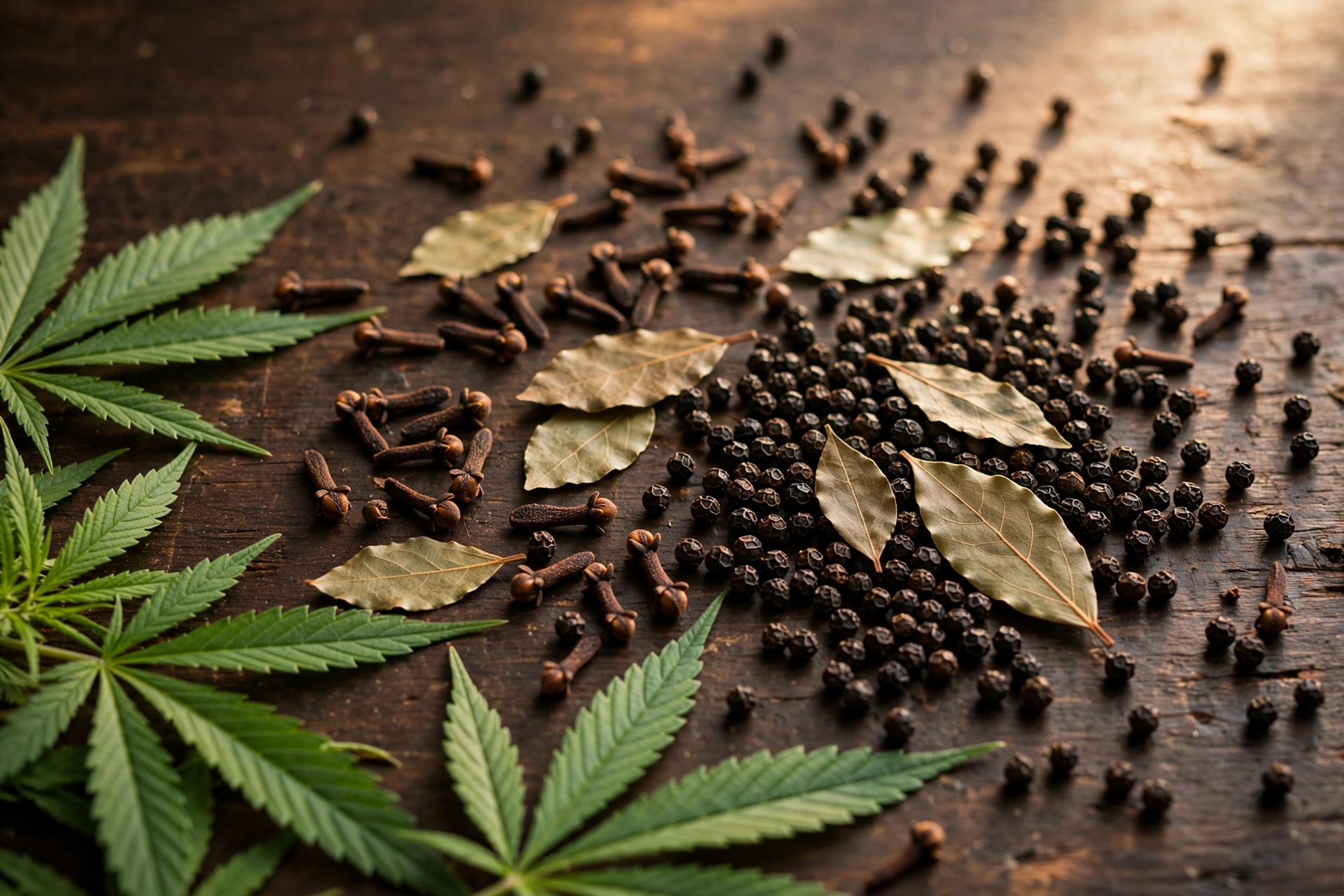
Caryophyllene is a terpene, one of the aromatic compounds that give plants their smell and flavour. More precisely, beta-caryophyllene is a sesquiterpene — a 15-carbon molecule built from three isoprene units — and it turns up in the essential oils of well over a thousand plant species. If you have ever wondered what makes black pepper smell like black pepper, a good part of the answer is this molecule.
You will also meet a close relative, caryophyllene oxide, which forms as beta-caryophyllene ages and oxidises. It smells woodier and is, funnily enough, the compound drug-sniffing dogs are trained to detect in cannabis. Same family, different molecule — and the research on one does not automatically apply to the other.
What does caryophyllene smell and taste like?
Spicy, warm, and woody, with a peppery bite — think cracked black pepper, a clove-studded orange, or the warm edge of cinnamon. In cannabis, strains rich in caryophyllene tend to smell peppery and a little funky, with a warmth that sits at the back of the nose rather than the front. It is the terpene most responsible for that “this smells like a spice cupboard” moment when you open a jar.
That aroma is caryophyllene’s day job. Before anyone cared about receptors, flavour chemists and perfumers knew it as a workhorse scent compound — it is used as a food flavouring, and the US Food and Drug Administration lists it as generally recognized as safe (GRAS) for that use. You have been eating it your whole life, most likely without ever knowing its name.
Where does caryophyllene come from?
Your spice rack, mostly. Black pepper is the classic source — caryophyllene is a big part of its bite — and it also shows up in cloves, cinnamon, oregano, basil, hops, and rosemary. It is common enough in everyday food that researchers call it a dietary cannabinoid, a label we will come back to in a moment. Wikipedia’s caryophyllene entry catalogues the main plant sources and how much of their essential oil is caryophyllene.
In cannabis, it is one of the most abundant terpenes, making up anywhere from a few percent to more than a third of the essential oil in the flower, depending on the strain and how it was grown and cured. That is a wide range, and it is one reason two jars with the same strain name can smell quite different. Our guide to cannabis terpenes explains how these compounds are measured and what a lab report actually tells you.
Why do researchers call it a “dietary cannabinoid”?
In 2008, a team led by Jürg Gertsch at the Swiss Federal Institute of Technology published a study in the Proceedings of the National Academy of Sciences that changed how scientists thought about this molecule. Screening it against both known cannabinoid receptors, they found it bound selectively to CB2 — the receptor more associated with immune signalling and tissue outside the brain — and behaved as a full agonist there, switching the receptor fully on, with an inhibition constant of about 155 nanomolar. Against CB1, the receptor behind the THC high, they found no measurable affinity at all.
The same study fed beta-caryophyllene to mice at 5 mg per kilogram and saw reduced inflammation in normal mice, but not in mice genetically lacking CB2 receptors — a neat bit of evidence tying the effect to that receptor. And because the compound is an ordinary part of food plants, the authors called it a dietary cannabinoid and put the phrase in the paper’s title. A 2023 review of the preclinical research still describes it as a CB2 agonist with insignificant affinity for CB1, and notes the FDA’s generally recognized as safe designation for food use.
One honest wrinkle: later cell studies using human receptors have disagreed about how strongly this plays out. A 2019 study found that beta-caryophyllene and five other common terpenes did not activate human CB1 or CB2 receptors in cell tests, and a 2020 study reached a similar conclusion. So the receptor story is real in the original lab work, but the evidence is mixed — and that is exactly why nobody should treat a terpene on a label as a promise. A clear-eyed look at what the human evidence on terpenes actually shows lays out both sides of that disagreement.
Does caryophyllene get you high?
No — and this is the easiest part of the whole story. The high from THC works through CB1 receptors in the brain, and beta-caryophyllene does not meaningfully touch CB1. That is why no amount of black pepper has ever made anyone high, and why a cannabis strain rich in caryophyllene is not automatically a stronger high than one without it. If a product promises a “peppery high” from caryophyllene alone, that is marketing, not science.
Terpenes shape aroma and flavour; they are not a second set of cannabinoids. Myrcene, the earthy terpene behind the classic cannabis smell, gets the same treatment — people credit it with effects the human evidence does not support. Enjoy the smell, by all means. Just do not buy the story that the smell is doing the work.
What does the research actually say — and what doesn’t it say?
The honest version is short: the animal and cell research is interesting, and the human research is thin. In rodents, beta-caryophyllene has reduced inflammatory signalling and pain-related behaviour in several models, often with evidence pointing at CB2, and animal work has also looked at anxiety-like behaviour, gut inflammation, and substance-seeking. All of it used isolated beta-caryophyllene, usually at doses far above anything you would get from food or a cannabis product.
In people, the trials are few and small. A 2019 randomised trial gave 126 mg a day for eight weeks to 66 people with H. pylori infection; nausea and stomach pain improved, but the infection itself did not clear. Another small trial gave 100 mg a day to 52 women and saw food-addiction questionnaire scores fall, with no change in body composition or appetite. A crossover study in 24 healthy adults tested a single 100 mg dose mainly to see how much reached the bloodstream. That is roughly the whole human picture — and no controlled human trial has tested beta-caryophyllene for inflammation or pain.
So if you see a product claiming caryophyllene “relieves pain” or “calms anxiety,” read it as a hope, not a fact. The mechanism is real in the lab, the bridge to people has not been built, and the doses in the animal studies would be hard to reach from a joint or a gummy. For the bigger question of whether terpenes change a cannabis high at all, our guide to the entourage effect walks through what the evidence does and does not support.
How can you spot caryophyllene in cannabis?
Two ways: your nose and a lab report. A peppery, spicy, clove-like nose is a decent clue, and many dispensaries and brands now print terpene profiles on the label or the certificate of analysis. Look for “beta-caryophyllene” or “BCP” among the top two or three terpenes — if it sits at the top of the list, the strain is usually described as caryophyllene-dominant.
A word of caution, though: do not shop by terpene alone. Terpene profiles vary from batch to batch, labels are not always accurate, and — as we have seen — there is no human evidence that a caryophyllene-rich strain will feel a particular way. Treat the terpene profile as a flavour guide, which is what it is good at, and let the cannabinoid content and your own experience do the rest.
Frequently asked questions
What is caryophyllene?
Caryophyllene, usually called beta-caryophyllene or BCP, is a terpene found in black pepper, cloves, cinnamon, and cannabis. It gives those plants a warm, peppery, spicy aroma. It is the only terpene known to activate the body’s CB2 cannabinoid receptor, which is why researchers call it a dietary cannabinoid.
Does caryophyllene get you high?
No. The cannabis high works through CB1 receptors in the brain, and beta-caryophyllene does not meaningfully bind to CB1 — it targets CB2 instead. That is why eating black pepper, cloves, or cinnamon has never made anyone high, and why a caryophyllene-rich strain is not automatically stronger than any other.
What foods contain caryophyllene?
Black pepper is the best-known source, and caryophyllene also appears in cloves, cinnamon, oregano, basil, hops, and rosemary. It is so common in everyday cooking that most people eat small amounts of it regularly without realising it. The US Food and Drug Administration lists it as generally recognized as safe for use as a food flavouring.
Is caryophyllene safe?
As a food flavouring, yes — the US Food and Drug Administration lists beta-caryophyllene as generally recognized as safe, and people have eaten it in pepper and spices for centuries. That safety record covers food amounts, though, not concentrated extracts or supplements. If you use a concentrated caryophyllene product, talk to your doctor first, especially if you take prescription medicines.
Does caryophyllene help with pain or inflammation?
Animal and cell studies suggest it may reduce inflammation through the CB2 receptor, but no human trial has tested it for pain or inflammation. The human trials are small and looked at other things, like stomach symptoms and food-addiction scores. Do not use a caryophyllene product as a treatment — talk to your doctor about options with evidence behind them.
This article is general information, not medical advice. Beta-caryophyllene is an interesting molecule, but the human evidence is thin, and no terpene product should replace advice from your doctor. If you take prescription medicines or have a health condition, talk to your doctor before using any cannabinoid or terpene product. See our medical disclaimer.
For a broader overview of cannabinoid guides on this site, see our THC and cannabinoids hub.
Affiliate Disclosure
The CakeHeights Editorial Team is committed to providing accurate, research-backed information about cannabis and hemp products. Some links on this page are affiliate links, meaning we may earn a commission at no extra cost to you if you make a purchase through them. Our recommendations are based on independent research, testing, and analysis. We only promote products we believe offer genuine value to our readers. Learn more →

Related Articles
 THC & Cannabinoids
What Is Linalool? The Lavender Terpene, Explained
 THC & Cannabinoids
How to Buy Delta-9 Online Safely: Lab Reports, Labels, and Shipping
 THC & Cannabinoids