
Table of Contents
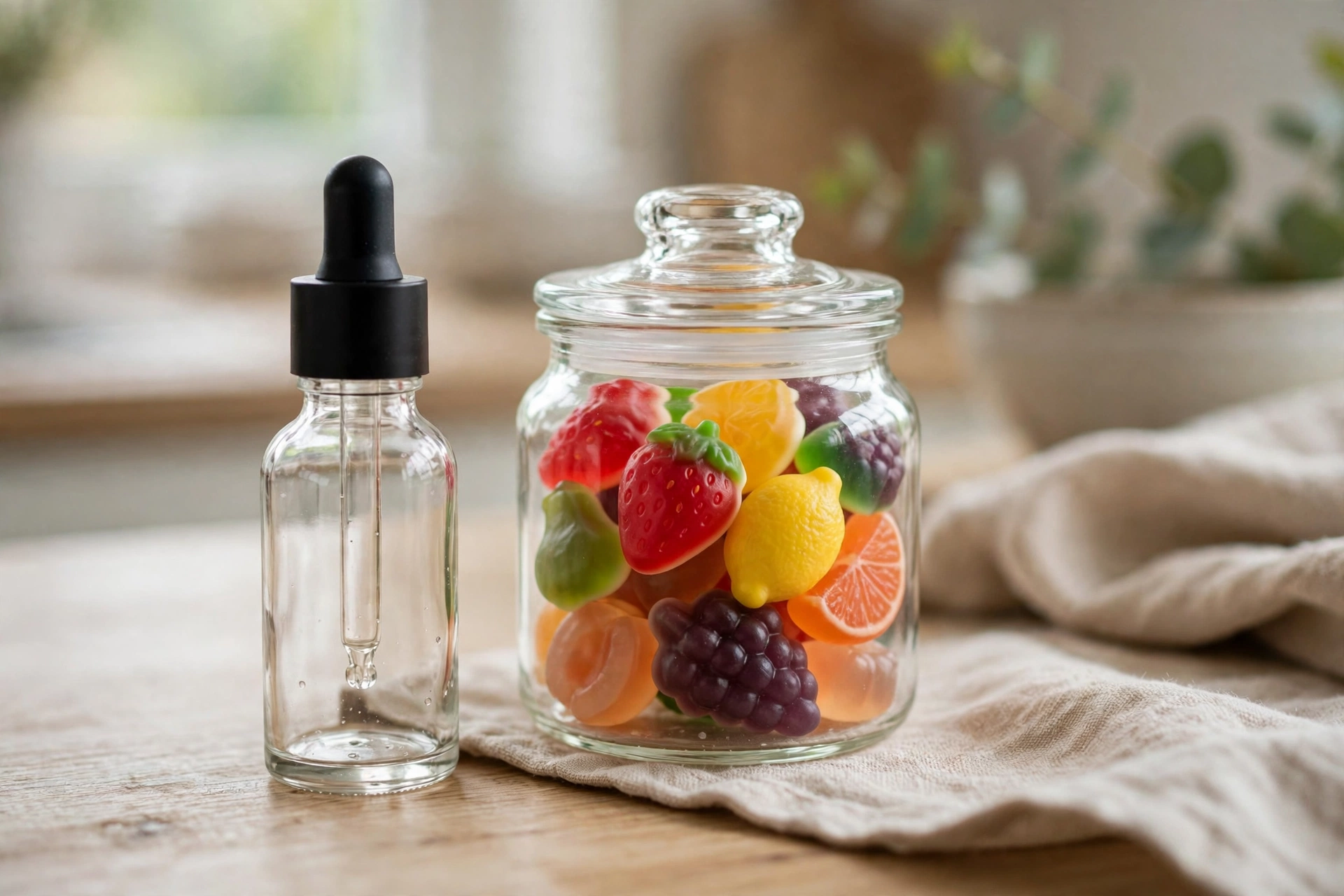
CBD gummies and tinctures deliver the same compound in very different ways. Gummies are swallowed and digested, so they start slower and may last longer. Tinctures held under the tongue can start sooner and let you adjust the amount drop by drop. Your schedule, taste, and need for control decide the better fit.
How do CBD gummies and tinctures compare at a glance?
| Point | CBD gummies | CBD tinctures |
|---|---|---|
| How you take it | Chewed and swallowed | Drops held under the tongue, then swallowed |
| Typical onset | 30–90 minutes | Often sooner than a swallowed edible; part of the dose is still swallowed |
| Typical duration | Often described as 6–8 hours | Often described as shorter than a gummy, commonly 4–6 hours |
| Amount control | Fixed amount per piece | Dropper lets you adjust in small steps |
| Taste | Sweet and fruity, often with sugar | Earthy, oily, sometimes bitter |
| Discretion | Looks like a regular sweet | Small bottle, but using a dropper is more visible |
Those ranges match the pattern in our wider comparison of CBD gummies, capsules, and vapes compared side by side. Your own timing will vary, so treat the table as a rough shape, not a promise.
Onset and duration: why does the route matter so much?
A gummy takes the long way in. You chew and swallow it, it moves through your stomach and gut, and the CBD passes through your liver before reaching the rest of your body. That first pass breaks down a large share of the CBD, which is why a gummy is slow to start and less of each milligram ends up in circulation.
A tincture is meant to shortcut part of that trip: drops held under your tongue let some CBD absorb through the tissue in your mouth and reach the blood without going through the gut first. Our guide to how long to hold CBD oil under your tongue explains why hold time matters. The honest catch: part of almost every tincture dose gets swallowed anyway, and that part follows the same slow, liver-first route as a gummy.
That split route is also why the research picture is less tidy than most product pages suggest. A 2018 systematic review by Millar and colleagues in Frontiers in Pharmacology found that the oral figure of around 6% for CBD bioavailability was an estimate never directly measured in humans, with no single reliable figure for the under-the-tongue route. A later review in The Permanente Journal put oral CBD at about 6% as well. Swallowing is the slower, less efficient route, and holding a tincture may get some of it in sooner — but no honest source turns that into a precise percentage or a guaranteed start time for you.
Food muddies the water further: the same research found that a high-fat meal can raise oral CBD exposure several times over compared with an empty stomach, so keep the food situation similar while you compare. Duration follows the same logic — a slowly digested gummy is often described as lasting six to eight hours, a tincture as fading sooner. Neither figure is a rule.
Dosing precision: fixed pieces or a dropper?
This is where the two forms feel most different day to day. A gummy is pre-measured: the label states an amount per piece, and the piece you eat is the amount you get. Nothing to count or spill. Some people cut a gummy in half for a smaller amount, but the CBD may not be spread evenly through the piece, so a half is not always a true half.
A tincture works the other way. The bottle states an amount per full dropper or per millilitre, and many droppers are marked, so you can adjust in small steps rather than jumping by a whole piece at a time. Our guide to CBD tinctures, their benefits and dosage walks through how dropper markings and bottle strengths work. We are describing the mechanics here, not recommending an amount: there is no well-established standard amount for over-the-counter CBD, and research is still early.
One caution applies to both forms. The US Food and Drug Administration (FDA) notes that many CBD products it has tested did not contain the levels their labels claimed. A third-party lab report for your exact batch matters more than the number in large type: a pre-measured gummy is only as precise as its maker.
Taste and sugar: sweet treat or earthy oil?
For a lot of people, this section settles it. Gummies taste like sweets because, in most cases, they are sweets: a gummy base, flavouring, and often sugar or another sweetener, with CBD mixed in. That makes them easy to take, but it also adds sugar to your day, may not suit a low-sugar eating pattern, and means they need storing where children and pets cannot mistake them for ordinary candy. If you are new to the format, our explainer on what CBD gummies are and how they are made covers the ingredients in more detail.
Tinctures taste like the plant and the carrier oil: earthy, grassy, or slightly bitter, with an oily texture that lingers. Flavoured tinctures soften that but rarely hide it. Some people do not mind; others find the taste is why they stop using a bottle they paid for. A form you dislike is one you will not use consistently. There is no health winner here — check the ingredient list either way, because sweetened tinctures and sugar-free gummies both exist.
Discretion and travel: which one fits in a bag better?
At home or at work, gummies are the quieter option: eating one looks like eating a sweet, with no smell and no equipment. A tincture is still small and portable, but holding a dropper under your tongue for a minute is harder to do unnoticed in a meeting.
For travel, both forms are compact and need no charging or accessories. A tincture bottle is glass and liquid, so it can leak or break and it counts toward liquid limits when you fly. Gummies avoid the liquid issue, but they can melt in a hot car — one more reason to keep them in their original, labelled packaging.
On the legal side, check before you go. As of November 2026, the Transportation Security Administration (TSA) states that marijuana and certain cannabis-infused products, including some CBD oil, remain illegal under federal law except for products with no more than 0.3 percent THC on a dry weight basis or FDA-approved products. Rules abroad vary widely, and some countries treat CBD far more strictly. This is general information, not legal advice: check your destination’s rules before packing either form.
Cost: how do you compare without a price tag in front of you?
We are not going to quote prices, because they change and vary too much by brand and seller to be useful here. Instead, compare two labels this way: work out the cost per milligram of CBD. Take the total milligrams in the bottle or packet — not the number of pieces, not the weight of the whole product — and compare that against what you would pay. That stops a large, weak product from looking like better value than a small, strong one.
Then adjust for the route. Because a swallowed gummy loses a large share of its CBD to first-pass metabolism, labelled milligrams in a gummy and in a tincture are not quite the same thing in practice. Cost per milligram is a starting point, not the whole answer: the form you enjoy, can measure comfortably, and will actually use tends to be the better value for you.
So, which one is right for you?
Choose gummies if you want the simplest routine: a fixed amount per piece, a taste you will not dread, and a longer-lasting form you can take and forget about for hours. Accept the patience needed at the start, the sugar most gummies bring, and clumsy fine adjustments.
Choose a tincture if you want control: small-step adjustments, a likely earlier start, and no candy in the equation. Accept the earthy taste, the minute spent holding drops under your tongue, and a glass bottle that needs care when you travel.
If you are torn, think about the moment you plan to use it: a long, steady day points toward the gummy, a situation where timing matters more toward the tincture. And if you take prescription medicines or have a health condition, neither choice should come before a conversation with your doctor. The National Center for Complementary and Integrative Health (NCCIH) notes that research on cannabinoids for most conditions is still in its early stages, and the FDA has approved only one CBD product, the prescription medicine Epidiolex, for certain rare seizure disorders. For more comparisons, browse our CBD guides hub.
Frequently asked questions
Which works faster, CBD gummies or tinctures?
A tincture held under the tongue usually starts sooner, because some CBD can absorb through the tissue in your mouth instead of waiting for digestion. A gummy must be chewed, swallowed, and processed first, so onset is often described as thirty to ninety minutes. Part of every tincture dose is still swallowed, though.
Do CBD gummies last longer than tinctures?
Often, yes, at least as most guides describe them. A gummy is digested slowly, so its effects are commonly put at six to eight hours. A tincture is commonly described as lasting around four to six hours. Your body, the product, and whether you ate recently can all stretch or shorten those rough ranges considerably.
Are tinctures stronger than gummies?
Not automatically. Strength depends on how many milligrams are in the bottle or packet, and on the route. Swallowed CBD loses a large share to first-pass metabolism in the liver, while some tincture CBD may absorb under the tongue. Reviews put oral bioavailability at about six percent, an estimate, so labelled milligrams are not the whole story.
Do CBD gummies contain sugar?
Many do. A typical gummy is a sweet first: a gummy base, flavouring, and often sugar or another sweetener, with CBD mixed in. Sugar-free versions exist, so check the ingredient list rather than assuming. That candy-like taste and look are also why gummies should be stored away from children and pets, in their original packaging.
Can I switch between gummies and tinctures?
You can use different forms on different days, but switching makes it harder to tell what is doing what, especially while you are still learning how CBD affects you. Keep the form, timing, and food situation steady while you compare, change one thing at a time, and talk to your doctor if you take medicines.
This article is general information, not medical advice. Talk to your doctor before using any CBD product, especially if you take prescription medicines or have a health condition. See our medical disclaimer.
Affiliate Disclosure
The CakeHeights Editorial Team is committed to providing accurate, research-backed information about cannabis and hemp products. Some links on this page are affiliate links, meaning we may earn a commission at no extra cost to you if you make a purchase through them. Our recommendations are based on independent research, testing, and analysis. We only promote products we believe offer genuine value to our readers. Learn more →

Related Articles
 CBD Guides
Valerian Root vs Melatonin: Which Helps You Sleep?
 CBD Guides
How Long Does CBD Take to Work on Dogs?
 CBD Guides