
Table of Contents
Humulene is the terpene that gives hops — and beer — their earthy, woody character, and it turns up in cannabis too. It is often sold as an appetite suppressant, but no human study has ever shown that. What the research does support is narrower and more interesting: early animal work on inflammation.
What exactly is humulene?
Humulene, usually called alpha-humulene, is a sesquiterpene — a 15-carbon molecule built from three isoprene units — named after Humulus lupulus, the hop plant where it was first identified. It is a single eleven-membered ring, which makes it a floppy, open molecule compared with its close relative beta-caryophyllene, whose structure folds into a tight four-membered ring instead.
That family resemblance has caused a naming muddle. In older chemistry literature humulene is also called alpha-caryophyllene, and the two compounds are often found side by side in the same plants. They are not the same molecule, though, and research on one does not automatically apply to the other. Modern convention calls it alpha-humulene, or just humulene.
One more mix-up worth clearing up early: humulene is not humulone. Humulone is a bitter acid in hops that gives beer its bitterness, and studies of bitter hop extracts are not studies of humulene. When you see a headline about hops and appetite or weight, check whether the study tested the terpene or the bitter extract — they are different things.
What does humulene smell and taste like?
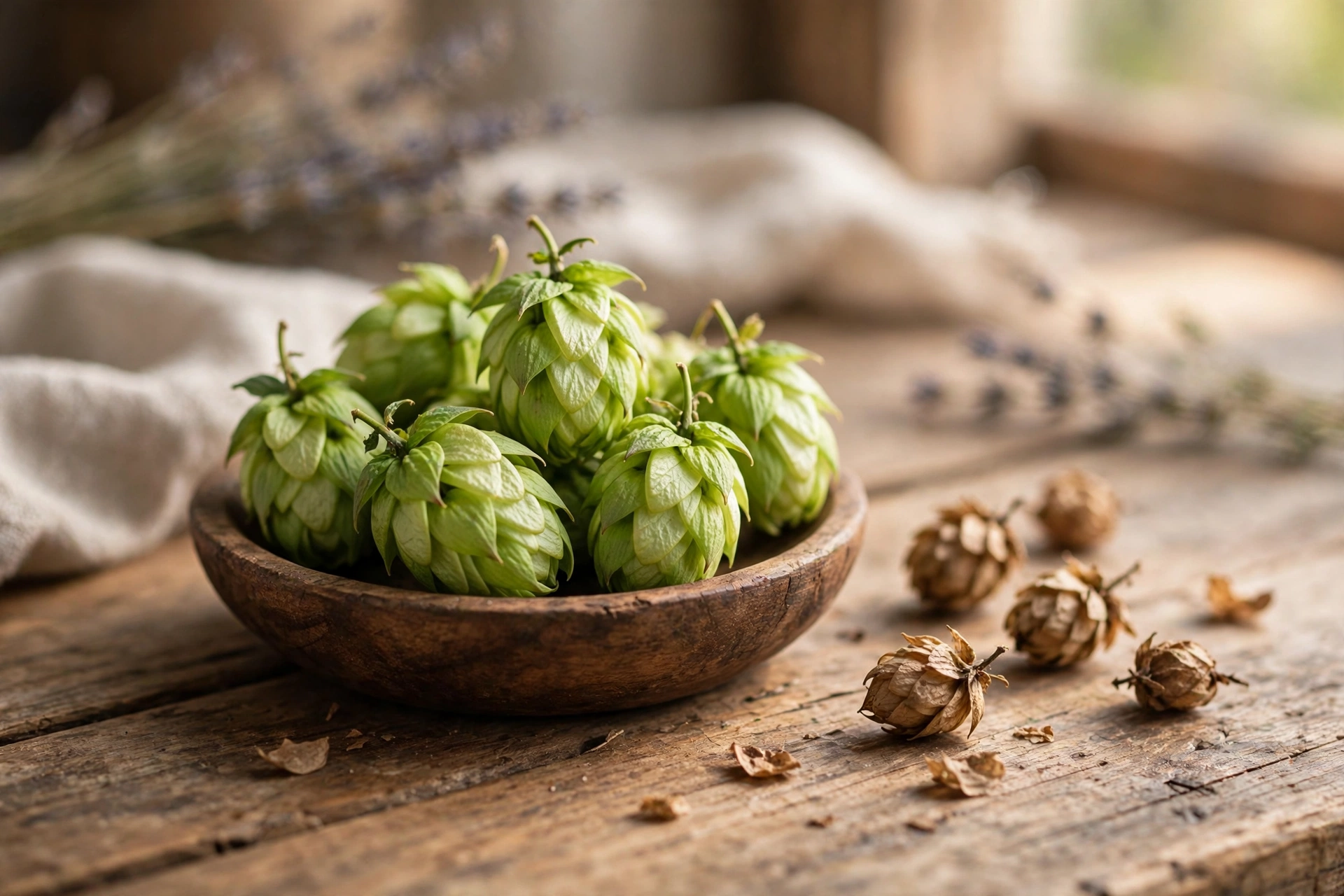
Earthy, woody, and hoppy, with a faintly spicy edge. It is the smell of a hop cone rubbed between your fingers, or the deep, resinous note underneath a well-hopped beer. In cannabis it adds depth rather than sweetness or citrus: a strain with humulene tends to smell grounded and herbal, like damp earth and dried herbs, rather than bright or fruity.
Humulene rarely works alone. It almost always appears alongside beta-caryophyllene — in one strain database it showed up in 116 strains and sat next to caryophyllene in every single one — which is partly why “hoppy, spicy” strains often have both. The pair share a peppery, woody family character, and together they shape the earthy end of the cannabis aroma spectrum. Our guide to cannabis terpenes explains how these compounds are measured and what a lab report actually tells you.
Where does humulene come from?
Hops, first and foremost. Humulene can account for a substantial share of hop essential oil, and its oxidation products — humulene epoxides, which form as hops are stored — are thought to contribute to the traditional “kettle-hop” aroma of beer. That is why brewers care about it: the same molecule that scents a hop cone ends up shaping how a beer smells in the glass.
Beyond hops, humulene turns up in cloves, basil, sage, and ginseng, and in smaller amounts in many other aromatic plants. In cannabis it is a common but usually secondary terpene — present in meaningful amounts in some strains, but rarely the dominant one. Like pinene, the pine-scented terpene, and myrcene, the earthy terpene behind the classic cannabis smell, it is one of the regulars on a terpene lab report rather than a rarity.
Does humulene get you high?
No. Humulene does not meaningfully interact with the CB1 or CB2 cannabinoid receptors in the classic 2008 binding study, and later work found it did not modulate THC’s activity at human CB1 or CB2 receptors either. It is an aroma compound, not a cannabinoid, and no amount of hops or basil has ever made anyone high.
That also means humulene on its own cannot explain the strength of a cannabis high. It may shape the smell and possibly the character of the experience, but the high itself comes from THC. If a product promises a “hoppy high” from humulene alone, that is marketing, not science.
What does the research actually say?
The honest summary is that humulene has a modest but real preclinical literature, almost all of it about inflammation. The most-cited work comes from Brazilian groups studying Cordia verbenacea, a plant whose essential oil contains both alpha-humulene and trans-caryophyllene.
In a 2007 study in the European Journal of Pharmacology, Fernandes and colleagues gave oral alpha-humulene to mice and rats in several inflammation models. It reduced paw swelling caused by carrageenan and other triggers, lowered the inflammatory signals TNF-alpha and interleukin-1beta, and reduced production of prostaglandin E2 as well as the enzymes iNOS and COX-2. The effects were comparable to dexamethasone, a potent steroid used as the study’s positive control, at a dose of 50 mg per kilogram in the animals.
Follow-up work in 2009 found that humulene had both preventive and therapeutic effects in a mouse model of allergic airway inflammation, given orally or inhaled. And a 2025 mouse study tested four cannabis terpenes in models of post-operative and fibromyalgia-type pain: geraniol had the strongest effect, with linalool and alpha-humulene next, and blocking the adenosine A2A receptor blocked the response — a mechanism with nothing to do with cannabinoid receptors.
All of that is animal work, and the doses were far above anything you would get from food, beer, or a cannabis product. No controlled human trial has tested humulene for inflammation or pain, and no human evidence exists for any other benefit. The preclinical picture is genuinely interesting — stronger than what most terpenes can show — but the bridge to people has not been built.
What about the appetite claim?
This is the part of the humulene story that needs a correction. Search humulene anywhere and you will read that it suppresses appetite — that it is the terpene that “offsets the munchies.” It is on dispensary menus, in strain descriptions, and in most articles written about the compound. It is the single most repeated thing anyone says about it.
But there are no controlled human studies showing it does anything of the kind. A scoping review of humulene research examined hundreds of studies and found interesting biology — including anti-inflammatory potential — but no clinical evidence that it suppresses appetite in people. The claim appears to have come from nowhere in particular and stuck around, crowding out everything genuinely interesting about humulene ever since.
Part of the confusion comes from hop extracts. A randomised crossover trial did look at a gut-targeted bitter hop extract, appetite hormones, and food intake — but that formulation was rich in hop bitter acids, not a trial of the terpene humulene. Evidence about a bitter extract cannot be borrowed to support a claim about an aroma compound. So if you want cannabis without hunger, the honest answer is that the data is not there yet for any terpene — and a humulene-rich label is not evidence that a product will keep you from the munchies.
How can you spot humulene in cannabis?
Two ways: your nose and a lab report. An earthy, woody, hoppy smell is a decent clue, and many dispensaries and brands now print terpene profiles on the label or the certificate of analysis. Look for “alpha-humulene” or “humulene” among the top terpenes — it usually sits in the middle of the list rather than at the top, often next to beta-caryophyllene.
A word of caution, though: do not shop by terpene alone. Terpene profiles vary from batch to batch, labels are not always accurate, and — as we have seen — there is no human evidence that a humulene-rich strain will feel a particular way. Treat the terpene profile as a flavour guide, which is what it is good at, and let the cannabinoid content and your own experience do the rest.
Frequently asked questions
What is humulene?
Humulene, usually called alpha-humulene, is a terpene with an earthy, woody, hoppy aroma, found in hops, cloves, basil, sage, and cannabis. It is a 15-carbon sesquiterpene named after the hop plant, Humulus lupulus, and it is also known in older literature as alpha-caryophyllene. It gives hops and beer much of their characteristic scent.
Does humulene suppress appetite?
No human study has shown that it does. The appetite claim is widely repeated on menus and in articles, but a scoping review of humulene research found no clinical evidence for appetite suppression in people. Studies of bitter hop extracts are sometimes cited by mistake, but those tested hop bitter acids, not the terpene humulene itself.
Does humulene get you high?
No. Humulene does not meaningfully interact with CB1 or CB2 cannabinoid receptors, and later work found it does not change how THC acts at those receptors either. It is an aroma compound, not a cannabinoid. A humulene-rich strain is not automatically stronger than any other, and eating hops or basil has never made anyone high.
Can humulene help with inflammation or pain?
Animal studies suggest it may reduce inflammation — a 2007 study found effects comparable to the steroid dexamethasone in rodents, and a 2025 mouse study found pain-related effects through the adenosine A2A receptor. But no human trial has tested humulene for inflammation or pain, so do not use a humulene product as a treatment — talk to your doctor.
Is humulene safe?
Humulene is a normal part of foods and plants — hops, cloves, basil, and sage all contain it — and it is widely used as a flavouring and fragrance ingredient. That safety record covers food and everyday exposure, not concentrated extracts or supplements. If you use a humulene product, talk to your doctor first, especially if you take prescription medicines.
This article is general information, not medical advice. Humulene is an interesting molecule, but the human evidence is thin, and no terpene product should replace advice from your doctor. If you take prescription medicines or have a health condition, talk to your doctor before using any cannabinoid or terpene product. See our medical disclaimer.
For a broader overview of cannabinoid guides on this site, see our THC and cannabinoids hub.
Affiliate Disclosure
The CakeHeights Editorial Team is committed to providing accurate, research-backed information about cannabis and hemp products. Some links on this page are affiliate links, meaning we may earn a commission at no extra cost to you if you make a purchase through them. Our recommendations are based on independent research, testing, and analysis. We only promote products we believe offer genuine value to our readers. Learn more →

Related Articles
 THC & Cannabinoids
What Is Pinene? The Pine-Scented Terpene, Explained
 THC & Cannabinoids