
Table of Contents
CBD and CBG are both non-psychoactive cannabinoids, and both come from the same starting point — but they are not interchangeable. CBD is the most-studied non-psychoactive cannabinoid, with human trials and one FDA-approved medicine (Epidiolex, for specific seizure disorders). CBG is the “mother cannabinoid” — the precursor from which CBD, THC, and CBC are made — and it is far less studied: no human trials exist. Here are the five differences that matter.
5 key differences
1. Origin: CBG is the precursor
CBGA (cannabigerolic acid) is the parent compound. Enzymes convert it into THCA, CBDA, and CBCA — which become THC, CBD, and CBC. By harvest, most CBGA has converted, which is why CBG is scarce in mature plants (<1%) and CBD is abundant. CBG products come from young plants or CBG-rich cultivars.
2. Evidence: decades vs none
CBD: human trials for epilepsy (Epidiolex approved), modest evidence for chronic pain and MS symptoms, early-stage research for everything else (per the NCCIH cannabis overview). CBG: no completed human trials. Glaucoma (one 1990 cat study), IBD (one mouse model), cancer (cell studies), MRSA (in vitro, Farha 2020) — all preclinical. See our CBG guide and our CBG FAQ guide.
3. Mechanism: different targets
CBD has low affinity for CB1/CB2 and acts via other targets (5-HT1A, TRPV1, adenosine, CYP450 inhibition). CBG binds CB1/CB2 directly (weakly) and also acts on TRP channels and alpha-2 adrenoceptors. The practical consequence: different interaction profiles, both incompletely understood.
4. Safety data: CBD known, CBG unknown
CBD’s risks are documented: liver injury (dose-dependent), drug interactions (CYP450), drowsiness, GI effects. CBG’s safety profile in humans is essentially unknown — no dose, no interaction data, no long-term data. See our evidence-graded CBD vs CBG comparison.
5. Price and availability: CBG costs more
CBG’s scarcity makes it more expensive. Both are sold in unregulated markets; the FDA’s warnings on unregulated cannabinoid products apply. Demand a batch-specific COA from an accredited lab for either. Legality follows the P.L. 119-37 framework (late 2026) — verify current law.
At a glance
| CBD | CBG | |
|---|---|---|
| Abundance | High | Low (<1% at harvest) |
| Psychoactive? | No | No |
| FDA-approved medicine | Yes (Epidiolex) | No |
| Human trials | Many | None completed |
| Known risks | Liver, interactions, drowsiness | Unknown |
Frequently asked questions
What are CBD and CBG?
CBD (cannabidiol) and CBG (cannabigerol) are non-psychoactive cannabinoids. CBG is the precursor (“mother cannabinoid”) from which CBD, THC, and CBC are synthesized in the plant.
How does CBD differ from CBG?
Different abundance, different mechanism, vastly different evidence: CBD has human trials and an approved medicine; CBG has no completed human trials.
What are CBG’s potential health benefits?
None established in humans. Antibacterial (MRSA, in vitro), anti-inflammatory (mouse model), and eye-pressure (one 1990 cat study) findings are all preclinical.
Can CBD or CBG get you high?
Neither is psychoactive. Neither produces the high associated with THC.
Are CBD and CBG legal to use?
Depends on jurisdiction; hemp-derived products follow the P.L. 119-37 framework (late 2026). Verify current law.
Browse the THC & Cannabinoids hub.
Affiliate Disclosure
The CakeHeights Editorial Team is committed to providing accurate, research-backed information about cannabis and hemp products. Some links on this page are affiliate links, meaning we may earn a commission at no extra cost to you if you make a purchase through them. Our recommendations are based on independent research, testing, and analysis. We only promote products we believe offer genuine value to our readers. Learn more →

Related Articles
 THC & Cannabinoids
Delta-8 THC Legal in North Carolina? Key Facts & Insights
 THC & Cannabinoids
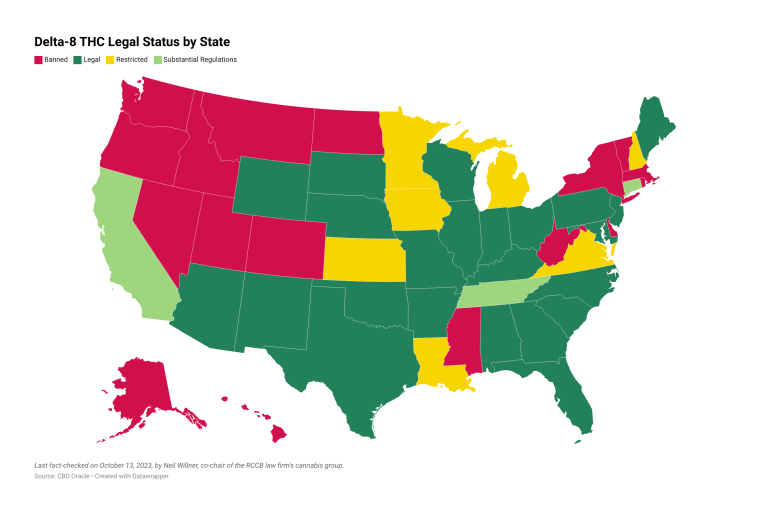
Delta-8 THC Legal Status: A Comprehensive 2023 Analysis
 THC & Cannabinoids