
Table of Contents
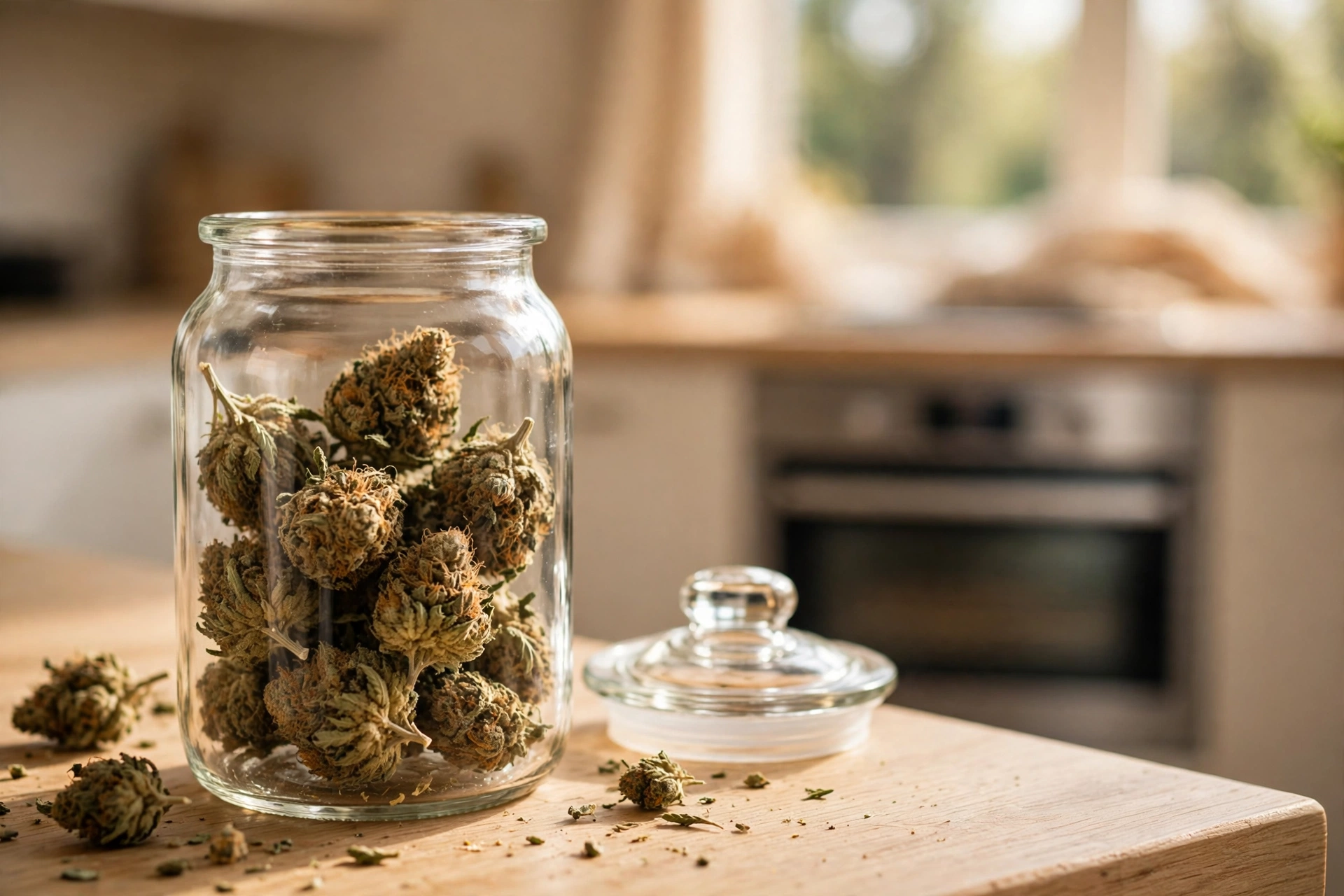
Decarboxylation is the heat-driven chemical change that turns raw cannabis from inactive to active. Fresh flower mostly contains THCA, not THC, and THCA will not get you high. Heat knocks a carbon dioxide molecule off THCA, leaving THC behind — which is why smoking works instantly and eating raw flower does almost nothing.
Why doesn’t raw cannabis get you high?
It feels like a trick question, but the plant genuinely does not make THC — at least, not in any amount that matters. A living cannabis plant makes THCA, tetrahydrocannabinolic acid, and stores it in the sticky trichomes on the flower. THCA is THC with an extra carboxyl group (COOH) bolted on, and that little add-on changes everything: THCA barely binds to the CB1 receptors in your brain, so it does not produce a high.
The same is true across the plant’s chemistry. Raw flower holds CBDA instead of CBD, and CBGA instead of CBG. The acids are the plant’s natural products; the neutral cannabinoids we talk about — THC, CBD, CBG — mostly show up after heat, light, or long storage does its work. THC gets most of the attention, but the plant makes dozens of cannabinoids, and THCP is one of the newest to get a name.
This is also why the “can I eat raw weed?” question comes up so often. The honest answer is that you can eat it — it just will not do what you hope. Your stomach acid does not decarboxylate THCA efficiently, and chewing a bud is a rough way to find that out.
What actually happens during decarboxylation?
The chemistry is simple enough to picture. Heat shakes the THCA molecule until its carboxyl group breaks away and floats off as carbon dioxide. What is left behind is THC. One molecule in, one molecule out, plus a puff of CO2 you would never notice.
Because a CO2 molecule leaves, the maths is not one-to-one. A milligram of THCA can yield at most about 0.88 mg of THC — the rest of the weight was the carboxyl group. Labelling that calls it “total THC” uses the formula THC + 0.877 × THCA for exactly this reason. So if a flower tests at 20% THCA, its maximum THC after full decarboxylation is roughly 17.5%, not 20%.
The reaction is not instant, and it is not magic. It follows first-order kinetics, which is a formal way of saying the speed depends on how much acid is left: fast at first, slower as the THCA runs out. That is why time and temperature always appear together in decarb discussions — neither one means much without the other.
How hot, and for how long?
The best-measured numbers come from a 2016 study by Wang and colleagues at the University of Mississippi, published in Cannabis and Cannabinoid Research. They heated cannabis extract in a vacuum oven at 80, 95, 110, 130, and 145°C and tracked the acids disappearing. THCA approached zero after about 30 minutes at 110°C (230°F), after 9 minutes at 130°C, and after 6 minutes at 145°C. Below 100°C, the reaction did not finish at all within an hour.
CBDA runs on a slower clock. In the same study, CBDA needed about 45 minutes at 110°C to fully convert to CBD, and its rate constants were roughly half those of THCA at every temperature tested. So a batch tuned for THC can leave a CBD-rich flower only partly converted — worth knowing if you work with high-CBD flower.
Home guides usually land in the same place: around 110°C (230°F) for 30–45 minutes is the commonly cited range, with the shorter end for THC and the longer end for CBD. The Wang et al. study is the measurement behind those numbers, and Project CBD’s decarboxylation guide gives the same 230°F neighbourhood for home use. Treat the range as a description of what the research found, not a prescription — ovens lie about their temperature, flower varies, and nobody’s kitchen is a vacuum oven.
Two things go wrong at the extremes. Too cool or too short, and much of the THCA never converts, leaving edibles weak for no good reason. Too hot or too long, and THC itself starts breaking down into CBN, a compound linked with heavy, sleepy effects, while the terpenes — the compounds behind smell and flavour — boil off first. That is the trade-off every decarb guide is quietly negotiating.
One last practical note: home ovens are famously optimistic about their own temperature, often running 10–15°C hotter or cooler than the dial says. If you are the careful type, an oven thermometer costs less than a takeaway and removes the biggest source of guesswork. And whatever you do, do not be tempted to crank the heat to save time — the time you save is paid for in lost THC and lost flavour.
Where decarboxylation happens without you noticing
Smoking and vaping do it for you, instantly and completely. A flame or a hot coil runs far hotter than decarboxylation needs, so THCA converts in the moment you inhale. That is the whole reason smoking works right away while edibles demand planning.
Cooking does it too, which is why the classic edible recipe starts with heating flower in butter or oil before it ever meets a brownie tin. The fat matters for a different reason — cannabinoids dissolve in fat, not water — but the heat is doing the decarb work. If you have ever wondered why your edible didn’t work, an incomplete decarb is one of the usual suspects, alongside eating it on an empty stomach or simply not waiting long enough.
Even time alone does some of it. THCA slowly converts to THC during drying, curing, and storage, which is why old flower can feel stronger than fresh flower in some ways — and why long-stored flower eventually drifts toward CBN and sleepiness instead. Light and air speed the process along, which is another reason to store flower in a cool, dark jar.
What decarboxylation changes about dosing
Here is where the chemistry turns practical. Smoking delivers decarboxylated THC straight to your lungs, so the effect arrives in minutes and you can judge it as you go. An edible delivers THC through your liver, which converts some of it into 11-hydroxy-THC — a form many people find stronger and longer-lasting. Same molecule at the start, very different ride.
That is also why edible dosing feels so unforgiving. A batch that was fully decarboxylated is simply stronger than one that was not, and you cannot tell by looking at it. If you are new to edibles, our guide to microdosing THC for beginners is the safer starting point: small amounts, long waits, and no second helping before the first one has had its say.
And if you have been using daily and edibles seem to have lost their punch, the chemistry is probably not the problem — your tolerance is. Our guide to how long a THC tolerance break takes explains why a pause resets things faster than raising the dose ever will.
Frequently asked questions
Can you eat raw cannabis to get high?
No — or at least, not in any way worth trying. Raw flower contains THCA, which does not bind to the brain’s cannabinoid receptors the way THC does. You would need to eat a large amount for almost no effect, and raw flower is harsh on the stomach. Heat is what unlocks the high.
What temperature decarboxylates weed?
In lab tests, THCA was nearly gone after 30 minutes at 110°C (230°F), and CBDA needed about 45 minutes at the same heat. Home guides usually cite 110°C for 30–45 minutes as the working range. Hotter is faster, but heat above 130°C starts destroying THC and flavour, so hotter is not better.
Does decarboxylation happen when you smoke?
Yes, instantly. A flame or a hot vape coil heats flower well past the point decarboxylation needs, so THCA converts to THC in the moment you inhale. That is the whole reason smoking and vaping work right away, while an edible made from raw flower would do almost nothing.
Does CBD need decarboxylation too?
Yes. Raw flower holds CBDA, the acid form of CBD, and heat converts it the same way — just more slowly. In the same 2016 lab study, CBDA needed about 45 minutes at 110°C, while THCA needed 30. A batch tuned for THC can leave a CBD-rich flower only partly converted.
Can you overdo decarboxylation?
Yes. Too much heat, or heat for too long, keeps breaking THC down into CBN, a compound linked with heavy, sleepy effects, and it burns off the terpenes that give flower its smell and flavour. The result is weaker, duller cannabis — which is why time and temperature are a trade-off, not a race.
This article is general information, not medical or legal advice. Decarboxylation and edible-making sit under different rules in different places — check your local laws before you start. See our medical disclaimer.
For a broader overview of cannabinoid guides on this site, see our THC and cannabinoids hub.
Affiliate Disclosure
The CakeHeights Editorial Team is committed to providing accurate, research-backed information about cannabis and hemp products. Some links on this page are affiliate links, meaning we may earn a commission at no extra cost to you if you make a purchase through them. Our recommendations are based on independent research, testing, and analysis. We only promote products we believe offer genuine value to our readers. Learn more →

Related Articles
 THC & Cannabinoids
What Is Pinene? The Pine-Scented Terpene, Explained
 THC & Cannabinoids