
Table of Contents
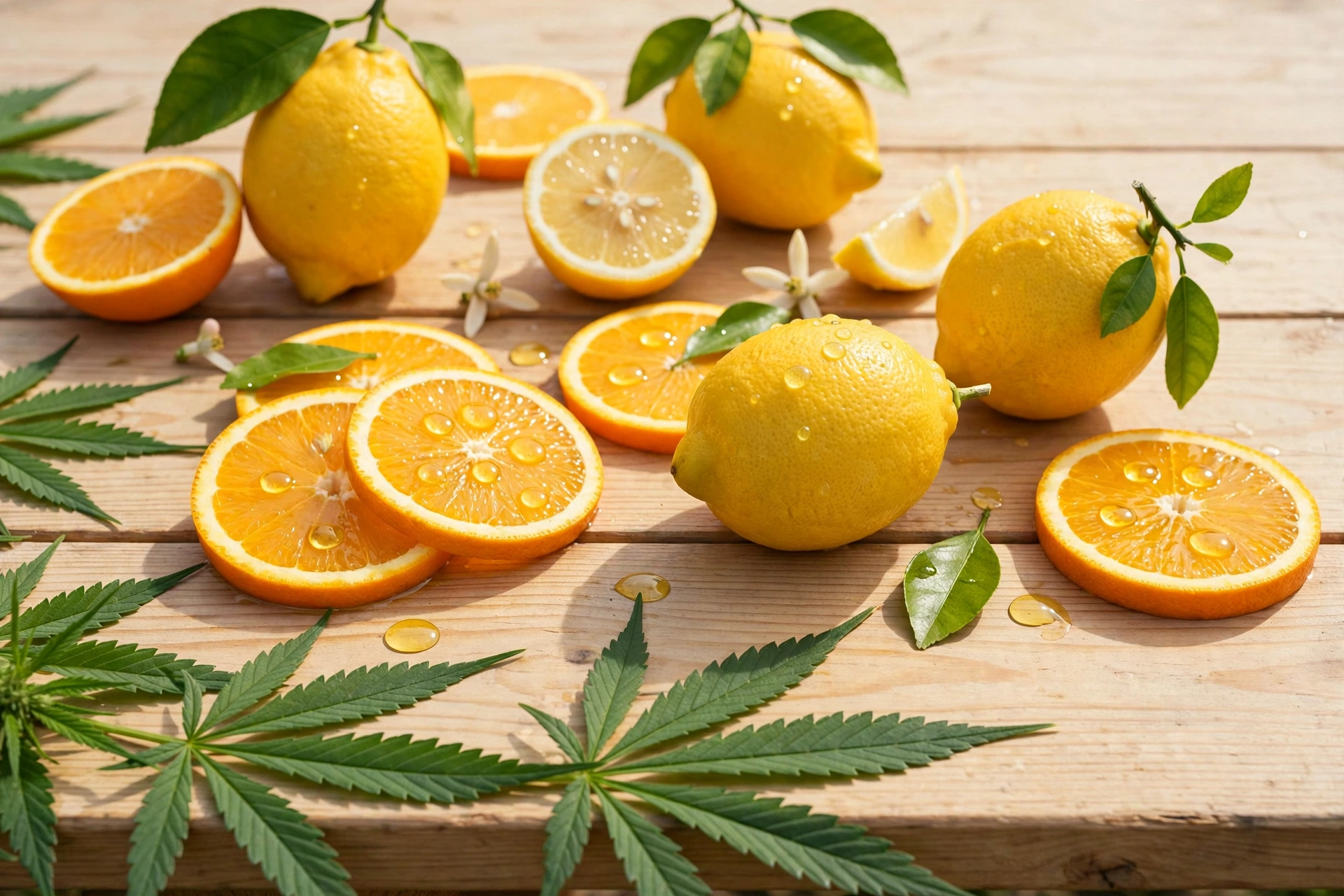
Limonene is the terpene behind the bright smell of a freshly peeled orange, and it shows up in cannabis too, giving some strains their citrusy nose. It is one of the most common terpenes in nature, but most of what you read about its effects comes from lab dishes and mice, not people.
What is limonene, exactly?
Limonene is a terpene, one of the aromatic oils plants make to smell the way they do. Chemically, it is a small ring-shaped hydrocarbon — a monoterpene with the formula C10H16 — and it is the major component of the oil in citrus fruit peels. Its name comes from the Italian limone, meaning lemon, which tells you exactly where people first noticed it.
Like a left hand and a right hand, limonene comes in two mirror-image forms. D-limonene is the one that dominates citrus peel, and it smells like sweet orange. L-limonene smells more piney, almost like turpentine, and turns up in plants such as caraway and dill. When someone says “limonene” without adding a letter, they almost always mean the d-form.
Terpenes do a job for the plant — they put off pests and lure in pollinators — but for us they are mostly a matter of smell and flavor. Limonene is the reason an orange smells like an orange before you ever taste it, and the same molecule is what makes some cannabis smell like a citrus grove. Our guide to cannabis terpenes, their types and effects explains how these aromatic compounds fit together across strains.
Where does limonene show up?
Citrus peel is limonene’s home turf. The oil sits in tiny glands dotted across the rind, which is why a squeezed orange peel sprays a fine, fragrant mist. Most of the limonene used in foods, drinks, cleaning products and perfumes is recovered from that peel — a byproduct of juice production, pressed or steam-distilled once the fruit has been squeezed.
It is far from a citrus-only molecule, though. Smaller amounts turn up in juniper, peppermint, rosemary, spearmint, dill and caraway, and in the resins of conifers. In cannabis, limonene is stored in the trichomes, the tiny resin glands on the flower, and it ranks among the most commonly reported terpenes, alongside myrcene, the earthy terpene that dominates most cannabis and caryophyllene, the peppery terpene.
How do you spot limonene in cannabis?
Your nose gets there first. A clear lemon or orange-peel note usually means limonene is in the mix, and strains described as citrusy or zesty tend to list it high on their lab reports. But smell is only a rough guide — it tells you limonene is present, not how much of it there is, and two batches of the same strain can smell quite different.
For anything firmer, read the certificate of analysis, the lab report that reputable sellers publish per batch. Terpenes are usually listed there as a percentage of the flower, and limonene will appear by name when it is present in measurable amounts. A strain can be limonene-forward, with limonene as its top terpene, or carry it as a supporting player behind a bigger terpene such as myrcene.
One honest warning: do not shop by terpene alone. Limonene is one note in a chord that includes cannabinoids, other terpenes and the dose itself, and none of those shows up in a smell. A citrusy nose is a nice clue, not a promise about how a strain will feel.
What does the research actually say?
Here is the short version: the human research on limonene is thin, and the one solid trial we have is narrow. Most of what you will read about limonene — calmer mood, less inflammation, better digestion — comes from cells in a dish or from rats and mice. Those studies can point researchers in a direction, but they cannot tell you what happens in a person.
The exception is a 2024 trial from Johns Hopkins, published in Drug and Alcohol Dependence. Twenty healthy adults who used cannabis now and then inhaled vaporized d-limonene alone, vaporized THC alone, the two together, or a placebo, across a series of double-blind sessions. On its own, d-limonene produced no effects that differed from placebo. But when 30 mg of THC was paired with 15 mg of d-limonene, participants rated themselves significantly less “anxious/nervous” and “paranoid” than with the same dose of THC alone — while the rest of the THC experience stayed the same. You can read the trial itself on PubMed, from Spindle and colleagues (2024), and Johns Hopkins Medicine’s own summary of the result.
That is a real finding, and it is also a small one. Twenty people, single sessions, vaporized compounds in a lab — not cannabis flower, not daily use, and not a test of limonene as a treatment for anxiety in general. The researchers themselves called it a first step. So the fair way to put it is this: limonene may soften some of THC’s edgy feelings in a controlled setting, and we do not yet know how far that stretches into real life.
What about the lab and animal studies?
Outside that one human trial, the work is preclinical — cells and animals — and it is worth knowing what it actually shows. In lab and animal studies, d-limonene has shown anti-inflammatory and antioxidant activity: in rats with stomach ulcers, for example, it lowered pro-inflammatory markers such as TNF-α, IL-6 and IL-1β and raised the anti-inflammatory marker IL-10, while protecting the stomach lining. Interesting, and a long way from a human result.
Digestion is where the human hints are closest, and they are still thin. A 2025 review of natural products for reflux noted two small studies, run under a US patent, in which d-limonene brought symptom relief to people with persistent heartburn — but it also said plainly that extensive clinical trials are still needed before anyone can call it a treatment. Animal work points the same way, with limonene protecting against stomach injury in rats without changing acid levels. The review is free to read on PubMed Central.
The pattern is the same across the board: promising signals in animals, very little tested in people. That is why you will not find a dose or a recommendation in this post — there is no human evidence strong enough to base one on, and anyone selling you one is getting ahead of the science.
Does limonene lift your mood?
This is the claim you will see most often, and it is the one with the least behind it. Limonene-rich strains get described as uplifting and bright, and that description gets repeated until it sounds like a fact. But the reputation comes from strain menus and user reports, not from controlled trials — and the one trial that tested limonene on its own found no mood effect at all compared with placebo.
There is a related idea worth naming honestly: the entourage effect, the theory that terpenes shape how cannabinoids feel. It is a genuine scientific hypothesis, and the 2024 trial is one of the first human tests of it — limonene did change one part of the THC experience, the anxious edge, without changing the rest. That is a long way from proof that a citrusy strain will put you in a good mood, though, and it says nothing about limonene by itself.
So if a menu tells you a limonene strain will make you happy, treat that as marketing, not medicine. What the evidence supports is narrower and more interesting: limonene may take some of the edge off THC, in a lab, at a specific dose.
Is limonene safe?
Limonene has been used to flavor food for a long time, and the amounts you meet in an orange, a soda or a cannabis flower are an ordinary part of eating and smelling plants. That is very different from concentrated limonene oil — the strong-smelling solvent sold for cleaning and fragrance — which is not the same thing as the trace amounts in a strain, and is not something to swallow neat.
As with any terpene or cannabinoid product, the sensible cautions apply: if you take prescription medicines, are pregnant, or have a health condition, talk to your doctor before trying a new product. And remember that limonene is not a treatment for anything — if anxiety or reflux is the problem, that is a conversation for a clinician, not a strain menu.
Frequently asked questions
What does limonene smell like?
Limonene smells like fresh citrus — mostly sweet orange and lemon zest, with a clean, bright edge. That is the d-limonene form, the one packed into citrus peel. Its mirror image, l-limonene, smells more piney and turpentine-like, and turns up in plants such as caraway and dill rather than in oranges.
Does limonene get you high?
No. Limonene on its own is not intoxicating, and in the 2024 Johns Hopkins trial, vaporized d-limonene alone produced no effects that differed from a placebo. Any high from a limonene-rich strain comes from THC and the other cannabinoids in it, not from the limonene itself.
Does limonene help with anxiety?
There is no good evidence that limonene on its own eases everyday anxiety. What one small human trial did find is narrower: vaporized d-limonene lowered ratings of anxious and paranoid feelings caused by THC, in 20 healthy adults. That is a lab result about THC, not proof that limonene calms stress in daily life.
Is limonene safe?
Limonene has long been used to flavor foods, and the amounts in citrus peel and cannabis flower are an ordinary part of eating and smelling plants. Concentrated limonene oil is a different thing — a strong-smelling solvent sold for cleaning and fragrance — not the trace amounts in a strain. If you take prescription medicines, ask your doctor first.
How can I tell if a strain is high in limonene?
Your nose is the first clue — a clear lemon or orange-peel scent usually means limonene is in the mix. For anything firmer, check the lab report: reputable sellers list terpenes on the certificate of analysis, with limonene shown as a percentage of the flower. Smell alone cannot tell you how much is there, or what it will do.
This article is general information, not medical advice. Limonene is not a treatment for any condition, and the research described here is early — mostly lab and animal work, plus one small human trial. If you take prescription medicines or have a health condition, talk to your doctor before using any cannabinoid or terpene product. See our medical disclaimer.
For a broader overview of cannabinoid guides on this site, see our THC and cannabinoids hub.
Affiliate Disclosure
The CakeHeights Editorial Team is committed to providing accurate, research-backed information about cannabis and hemp products. Some links on this page are affiliate links, meaning we may earn a commission at no extra cost to you if you make a purchase through them. Our recommendations are based on independent research, testing, and analysis. We only promote products we believe offer genuine value to our readers. Learn more →

Related Articles
 THC & Cannabinoids