
Table of Contents
Most dogs respond to CBD oil within 30 to 60 minutes, while treats and chews usually take 45 minutes to 2 hours because they must be digested first. Exact timing varies with the format, the amount, size, stomach, and what you are watching for. Slow, steady changes may take a week or two of daily use to notice.
How long does CBD take to work on dogs, by format?
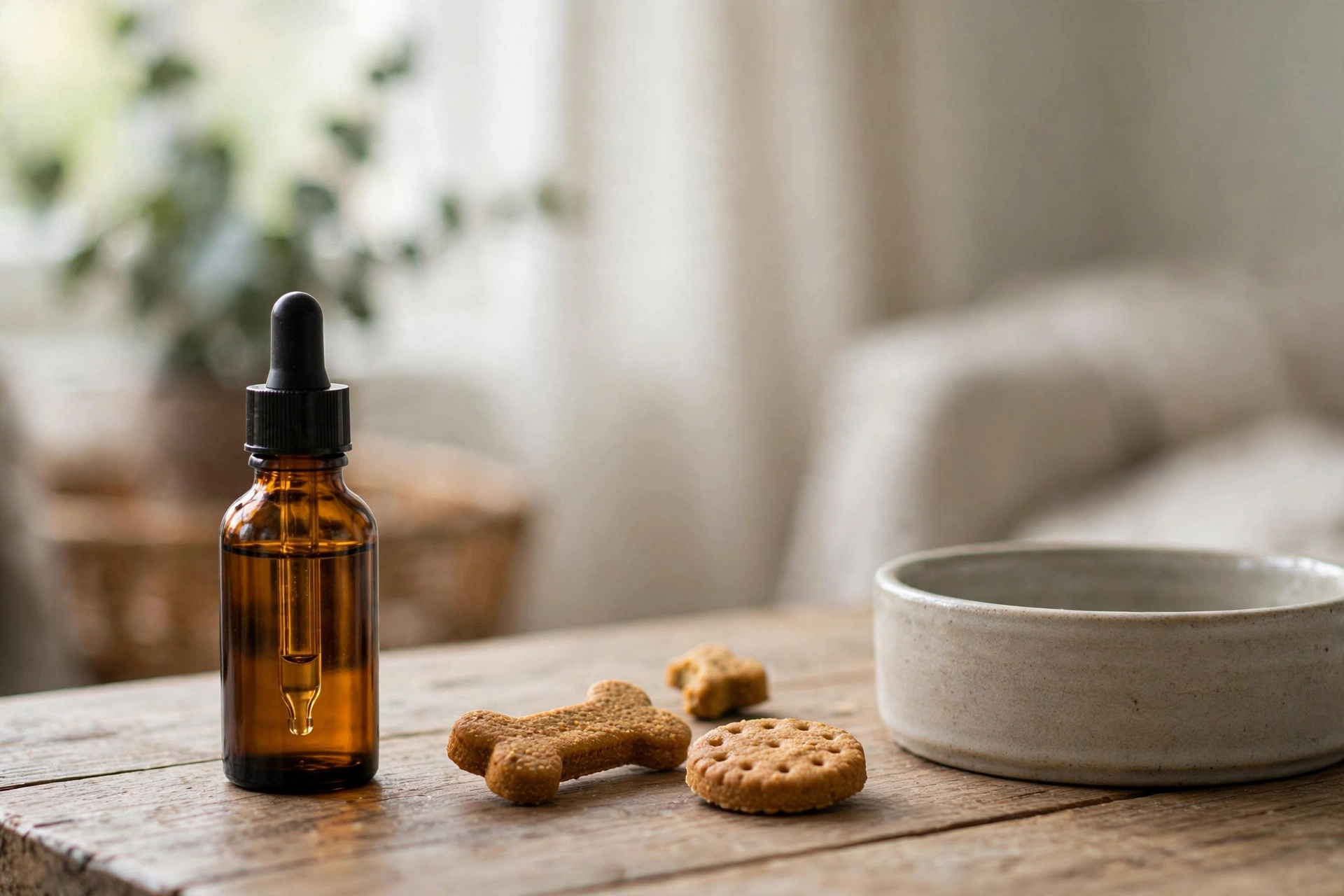
The format is the biggest timing factor, because it decides how fast the CBD reaches the bloodstream. Oil placed directly in the mouth can be partly absorbed through the gums and mouth lining, so it tends to act first. Treats, chews, and capsules have to travel through the stomach and intestines first, which adds time.
| Format | Typical onset | Why |
|---|---|---|
| Oil in the mouth (gums or under the tongue) | About 30–60 minutes, sometimes 20–40 | Some CBD absorbs through the mouth lining; the rest is swallowed |
| Oil mixed into food | About 45 minutes to 2 hours | Digestion slows things down, though a fatty meal may raise absorption |
| Treats and chews | About 45 minutes to 2 hours | Must be chewed, swallowed, and digested first |
| Capsules | About 45 minutes to 2 hours | Same digestive route as treats |
| Topical (on the skin) | Local area only, not whole-body timing | Acts where it is applied, not through the bloodstream |
These are reported ranges, not promises. One dog may settle within half an hour while another shows little change for two hours, even on the same product. Blood-level studies back up that spread: a pet-CBD guide summarizing the pharmacokinetic research puts peak CBD levels in the blood roughly 1 to 4 hours after an oral dose, with most studies landing near 1 to 2 hours. If you want the timing for a stressful event, give the oil 30 to 45 minutes ahead as a starting point and adjust from what you observe, with your vet’s guidance.
Why does oil work faster than treats?
It comes down to the route. Oil dropped onto the gums meets a thin, blood-rich lining, and some of the CBD can pass straight into the bloodstream without waiting for digestion. Dogs often swallow part of the oil, so not all of it takes that shortcut, but the part that does gives oil a head start.
Treats take the long road. They are chewed, swallowed, broken down in the stomach, and then processed by the liver before the CBD reaches the rest of the body. That first pass through the liver removes some of the CBD before it ever circulates, which is one reason treats can feel weaker as well as slower. The same logic explains why edibles behave differently from oils in people too — our guide to why an edible sometimes seems not to work covers the digestion and liver steps in detail.
Food changes the picture in both directions. Oil given on an empty stomach tends to act faster, often in that 30 to 60 minute window. Oil given with food, or mixed into a meal, tends to act more slowly, sometimes 60 to 120 minutes, but research suggests the total amount absorbed can be higher with food, especially fatty food. So a slower start does not always mean a weaker result.
What affects timing besides the format?
Size is the factor owners ask about most, and the honest answer is that it matters less than people expect. A small dog does not automatically respond faster than a large one, because the amount is usually scaled to weight, and digestion speed varies from dog to dog. Age, metabolism, and gut health all play a part, and a nervous dog may look calmer sooner than a comfortable dog shows any change at all, simply because the change is easier to spot.
What you are watching for matters even more. Calming before a thunderstorm or a vet visit is a short-term change you might notice the same day. Comfort and movement in an older dog with stiff joints is a slower story: the Cornell University study of dogs with osteoarthritis gave CBD oil twice daily for four weeks, and the improvements in pain scores and activity were measured over weeks, not minutes. Owners in that study reported no side effects, though blood tests showed a rise in a liver enzyme called alkaline phosphatase during treatment.
That split is worth keeping in mind. A single dose may help with a single stressful afternoon, while joint comfort and everyday mobility are usually judged over one to four weeks of steady use. If nothing changes after two weeks, that is useful information for your vet, not a reason to keep raising the amount on your own.
What should you watch for after giving CBD?
Watch your dog, not the clock. The signs people report most are subtle: a dog that paces less, settles sooner, breathes more slowly, or stops shadowing you from room to room. For an older dog, look for easier standing, a smoother first few steps in the morning, or more willingness to climb stairs. Keep a short note of the time, the amount, and what you saw — memory is unreliable, and a note makes patterns visible.
Also watch for side effects. Cornell University’s veterinary school notes that the most common side effects owners report are increased appetite and sleepiness, and that CBD can affect liver enzymes and interact with other medicines. Soft stools, vomiting, or unusual wobbliness are reasons to stop and call your vet. If your dog takes seizure medicine, pain medicine, or any drug processed by the liver, talk to your vet before the first dose, because CBD can change how those drugs perform.
One more thing to check: the product itself. No CBD product is approved by the FDA for use in animals, and Cornell found wide variation between pet CBD products, including some with no cannabinoids at all and some with heavy metal contamination. Choose a pet-specific product with a batch lab report, and skip human CBD products, which may contain xylitol or flavorings that are unsafe for dogs. Our guide to how much CBD to give a dog explains how published studies have approached amounts, and our guide to CBD for senior dogs covers the extra care older dogs need.
How do you time CBD for a stressful event?
Plan backward from the event, not forward from the dose. For a vet visit, a grooming appointment, or fireworks, give the oil about 30 to 45 minutes beforehand, and treats about an hour to 90 minutes beforehand. That gives the slower formats time to work and leaves room for a dog that runs slow.
Do a trial run first. Try the product on a calm day, at the same time of day you plan to use it, and watch what happens. A trial run tells you whether your dog accepts the format, how long the effect seems to last — usually about 4 to 8 hours for a single oral dose — and whether your dog gets sleepy. You do not want to learn any of that during a thunderstorm.
For ongoing needs, routine beats timing tricks. The Cornell study used twice-daily dosing, and the CBD stayed in the body with an elimination half-life of about 4.2 hours, which is why researchers dosed every 12 hours. Whatever schedule your vet agrees on, keep it steady for at least a week before judging it, and keep the notes going so you and your vet are working from observations, not guesses.
When should you call the vet instead of waiting?
CBD is not a substitute for veterinary care, and timing questions can hide a real problem. Call your vet promptly if your dog is in obvious pain, cannot stand or walk, has a seizure, vomits repeatedly, or suddenly refuses food and water. Those signs need a diagnosis, not a supplement.
Also call before starting CBD if your dog has liver disease, takes daily medicine, is pregnant, or is scheduled for surgery. And if your dog ever eats a THC product — a human edible, flower, or vape cartridge — call your vet or an animal poison control line right away. THC is toxic to dogs, and the signs, including wobbliness, dribbling urine, and extreme sleepiness, need professional help fast.
Finally, keep expectations honest. CBD may help some dogs with comfort and calm, and the research so far is small but real. It is not a cure, and it does not replace pain medicine, training, or a vet’s exam. Our CBD guides hub gathers our other pet and CBD guides in one place.
This article is general information only, not medical advice. Talk to your veterinarian before giving your dog CBD, especially if your dog takes other medicines or has liver disease. Read our medical disclaimer for the full details.
Frequently asked questions
How long does CBD take to work on dogs?
Most dogs respond to CBD oil within 30 to 60 minutes, while treats and chews usually take 45 minutes to 2 hours because they must be digested. Blood-level studies put peak CBD levels roughly 1 to 4 hours after an oral dose. For joint comfort, changes are usually judged over one to four weeks.
Does CBD work faster on an empty stomach?
Usually, yes. Oil given on an empty stomach tends to act in about 30 to 60 minutes, while oil given with food may take 60 to 120 minutes. The trade-off is that food, especially fatty food, may raise the total amount absorbed. A slower start does not always mean a weaker result, so follow your vet’s guidance on timing.
How long do the effects of CBD last in dogs?
A single oral dose generally stays active for about 4 to 8 hours in most dogs, then tapers off as the body processes it. The Cornell osteoarthritis study measured an elimination half-life of about 4.2 hours, which is why the researchers dosed twice daily. Individual dogs vary, so your own notes are the best guide to duration.
Why has CBD not worked for my dog yet?
It may be the format, the timing, or the goal. Treats act slower than oil, a single dose may be too early to judge for joint comfort, and some dogs respond less than others. Product quality varies widely, and some products contain far less CBD than the label claims. Ask your vet before changing the amount or switching products.
Is CBD safe for dogs?
CBD appears generally well tolerated in dogs in small studies, with sleepiness, soft stools, and a rise in a liver enzyme as the main concerns. No CBD product is FDA-approved for animals, and CBD can interact with other medicines. Never give a dog THC, and always check with your vet first, especially for dogs with liver disease.
Affiliate Disclosure
The CakeHeights Editorial Team is committed to providing accurate, research-backed information about cannabis and hemp products. Some links on this page are affiliate links, meaning we may earn a commission at no extra cost to you if you make a purchase through them. Our recommendations are based on independent research, testing, and analysis. We only promote products we believe offer genuine value to our readers. Learn more →

Related Articles
 CBD Guides
Do Dogs Have Cannabinoid Receptors?
 CBD Guides
CBD Gummies vs Capsules vs Vapes: Which Is Right for You?
 CBD Guides