
Table of Contents
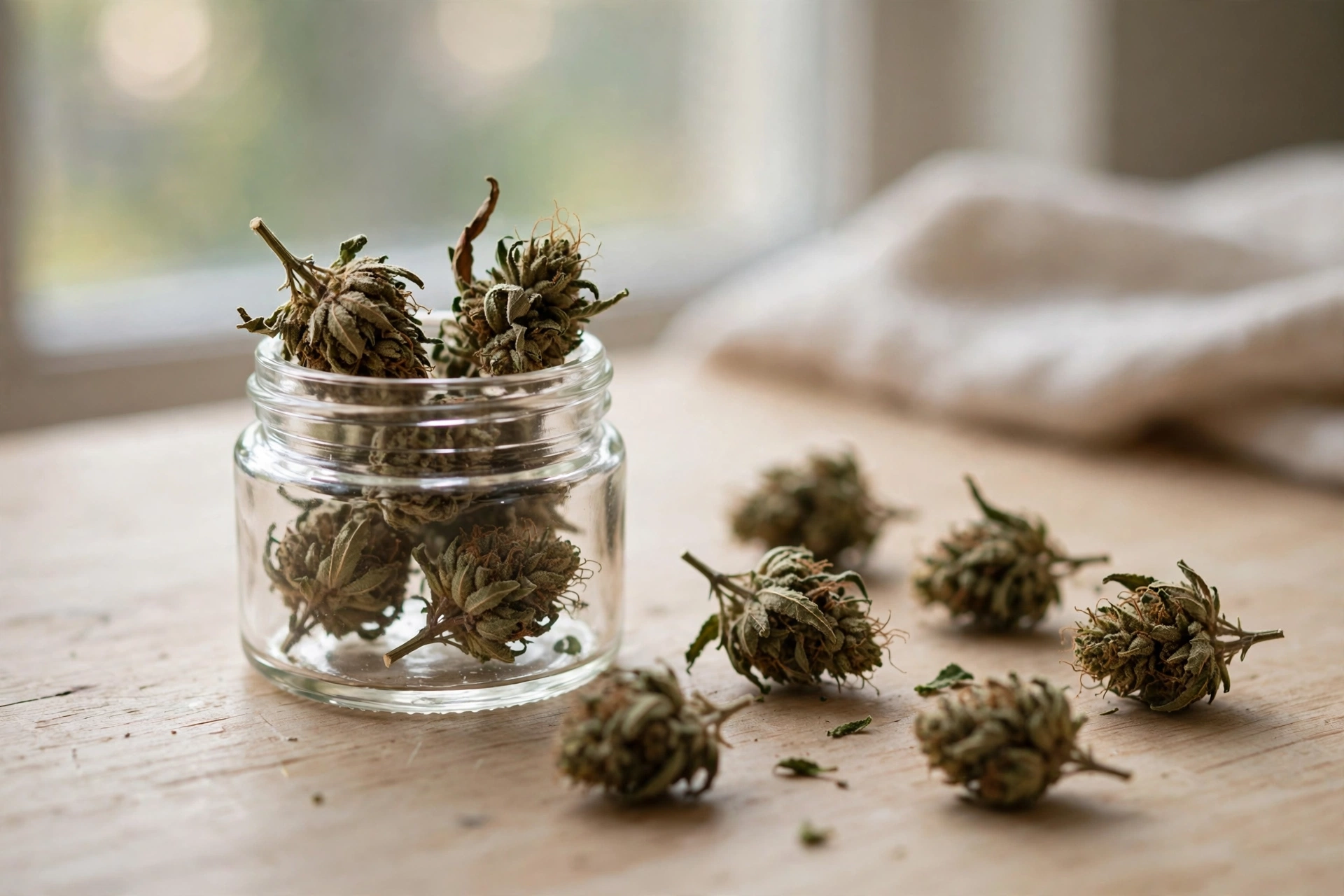
CBD dabs are concentrated hemp extracts — wax, shatter, crumble, budder, or isolate — vaporised on a heated surface and inhaled. They deliver a large dose of CBD in a single breath, with effects felt within minutes. That speed and potency is the whole appeal, and also the whole risk: dabbing is the least forgiving way to use CBD, it needs a torch and a rig, and the legal picture for hemp concentrates changed in late 2026. This guide covers the five forms, how dabbing actually works, and how to do it as safely as possible.
The five forms of CBD dabs
| Form | Texture | What to know |
|---|---|---|
| Wax | Soft, sticky, like beeswax | Easiest to handle; the usual starting form for beginners |
| Shatter | Hard, glass-like, snaps when broken | Stable and easy to portion; brittle — handle over a clean surface |
| Crumble | Dry, crumbly, less sticky than wax | Easy to measure small amounts; good balance of potency and handling |
| Budder | Whipped, butter-like, opaque | Soft and easy to scoop; texture comes from how the extract is purged and whipped |
| Isolate | Crystalline powder or slab | Pure CBD — typically 99%+ — with no other cannabinoids or terpenes |
Live resin is sometimes listed alongside these forms. It is made from fresh-frozen plant material rather than dried material, which preserves more terpenes — but the term describes the starting material, not a texture, and most live resin is THC-rich rather than CBD-rich. See CBD isolate vs CBD shatter for a deeper comparison of two of these forms.
Isolate vs full-spectrum dabs
Isolate dabs contain CBD and essentially nothing else. Full-spectrum dabs contain CBD plus other cannabinoids (including trace THC), terpenes, and flavonoids from the hemp plant. Some people prefer full-spectrum products because of the “entourage effect” — the hypothesis that cannabis compounds work better together than alone. That idea is widely repeated but unproven in humans; treat it as a theory, not a fact. The practical difference is simpler: full-spectrum products contain THC, which matters for drug testing and for impairment at high doses, while isolates do not. See does CBD get you high? for the THC picture.
How dabbing works — and the low-temperature technique
Dabbing needs a rig (a small water pipe), a quartz banger or nail, a dabber tool, a torch, and a carb cap. The classic method heats the banger and lets it cool before the dab goes in. The better method for flavour and comfort is the cold start: place a rice-grain-sized amount of concentrate in a cool banger, heat gently until it begins to vapourise, cap it, and inhale slowly. A glowing red-hot banger is too hot — it degrades terpenes, harshens the vapour, and wastes product. Start with the smallest amount you can handle; concentrates are potent, and you can always take a second dab, but you cannot take one back. Never dab and drive, and never dab in an unventilated room with an open torch flame near anything flammable.
Legality: the 2026 federal change
Hemp-derived CBD was federally legal in the US under the 2018 Farm Bill’s 0.3% delta-9 THC definition. That definition was rewritten in two steps: from November 12, 2026, cannabinoids the cannabis plant cannot naturally produce lost hemp status, and from December 11, 2026, the rest applies — THC measured as total THC (including THCA), a cap of 0.4 milligrams of total THC per container on finished products, and the exclusion of cannabinoids converted or synthesised outside the plant (P.L. 119-37, delayed in part by P.L. 119-103). State law adds another layer: some states ban hemp concentrates or smokable hemp outright, and some set earlier dates. The old blanket claim that every dab form is “legal” is no longer true anywhere without qualification. Check your state’s current rules before buying, and check the product’s certificate of analysis for total THC per container.
Safety and side effects
CBD is generally well tolerated, but dabs concentrate it — and inhalation adds its own risks. The US National Center for Complementary and Integrative Health notes CBD’s association with liver injury, drug interactions (via CYP450 liver enzymes), diarrhoea, sleepiness, and changes in appetite; read the NCCIH summary. Inhaling any vapour can irritate the lungs, and dabbing’s high temperatures add burn risk from the torch and hot glass. Do not use CBD dabs if you take prescription medication without talking to a clinician first — CBD can raise the levels of other drugs in your system. And do not assume a dab will help a medical condition: no CBD product is FDA-approved for pain, anxiety, or any condition other than certain seizure disorders (Epidiolex). For the broader product comparison, see CBD oil vs gummies and the CBD Guides hub.
Choosing quality dabs
| Check | What good looks like |
|---|---|
| Third-party lab report (COA) | Recent, batch-matched, showing CBD and total THC content plus contaminant testing |
| Extraction and purging | Residual-solvent testing on the COA — the method (CO2, ethanol, hydrocarbon) matters less than the test result |
| Colour and consistency | Colour is NOT a reliable quality signal; judge by the COA, not the shade |
| Labelling | CBD content per container, full ingredients, batch number, producer contact details |
Lab testing has repeatedly found mislabelled hemp products — see the lab study on mislabelled hemp products. No brand is recommended here: check the COA for the specific batch you are buying, because quality varies by batch, not just by brand.
The FDA’s CBD regulatory position explains the federal framework for CBD products.
Frequently asked questions
What are CBD dabs exactly?
Concentrated hemp extracts — wax, shatter, crumble, budder, or isolate — vaporised on a heated surface and inhaled, delivering a large CBD dose in a single breath.
How do CBD dabs differ from CBD oil?
Dabs are far more concentrated and act within minutes via inhalation; oils act more slowly and last longer. Dabs also need specialised equipment and carry inhalation risks oils do not.
What types of CBD dabs exist?
Wax, shatter, crumble, budder, and isolate — differing mainly in texture and purity — plus live resin, which describes fresh-frozen starting material rather than a texture.
Can CBD dabs get you high?
Pure CBD dabs cannot. Full-spectrum dabs contain trace THC, and at high doses or with a mislabelled product, impairment is possible. Check the COA for total THC.
Are CBD dabs legal to use?
It depends on the product and your state. Federal hemp law tightened in two steps in late 2026, and some states ban hemp concentrates outright. Check current state rules before buying.
Affiliate Disclosure
The CakeHeights Editorial Team is committed to providing accurate, research-backed information about cannabis and hemp products. Some links on this page are affiliate links, meaning we may earn a commission at no extra cost to you if you make a purchase through them. Our recommendations are based on independent research, testing, and analysis. We only promote products we believe offer genuine value to our readers. Learn more →

Related Articles
 CBD Guides
CBN vs Melatonin for Sleep: What’s the Difference?
 CBD Guides
CBD and Caffeine: Can You Mix Them?
 CBD Guides
Leave a Reply