
Table of Contents
Hemp seeds are food, not a drug: three tablespoons of hemp seeds pack about 10 grams of complete protein, half a day’s magnesium, and omega-3s in a roughly 3-to-1 omega-6 to omega-3 balance. They contain no meaningful THC, will not get you high, and are nothing like CBD oil — which comes from a different part of the plant.
What exactly are hemp seeds?
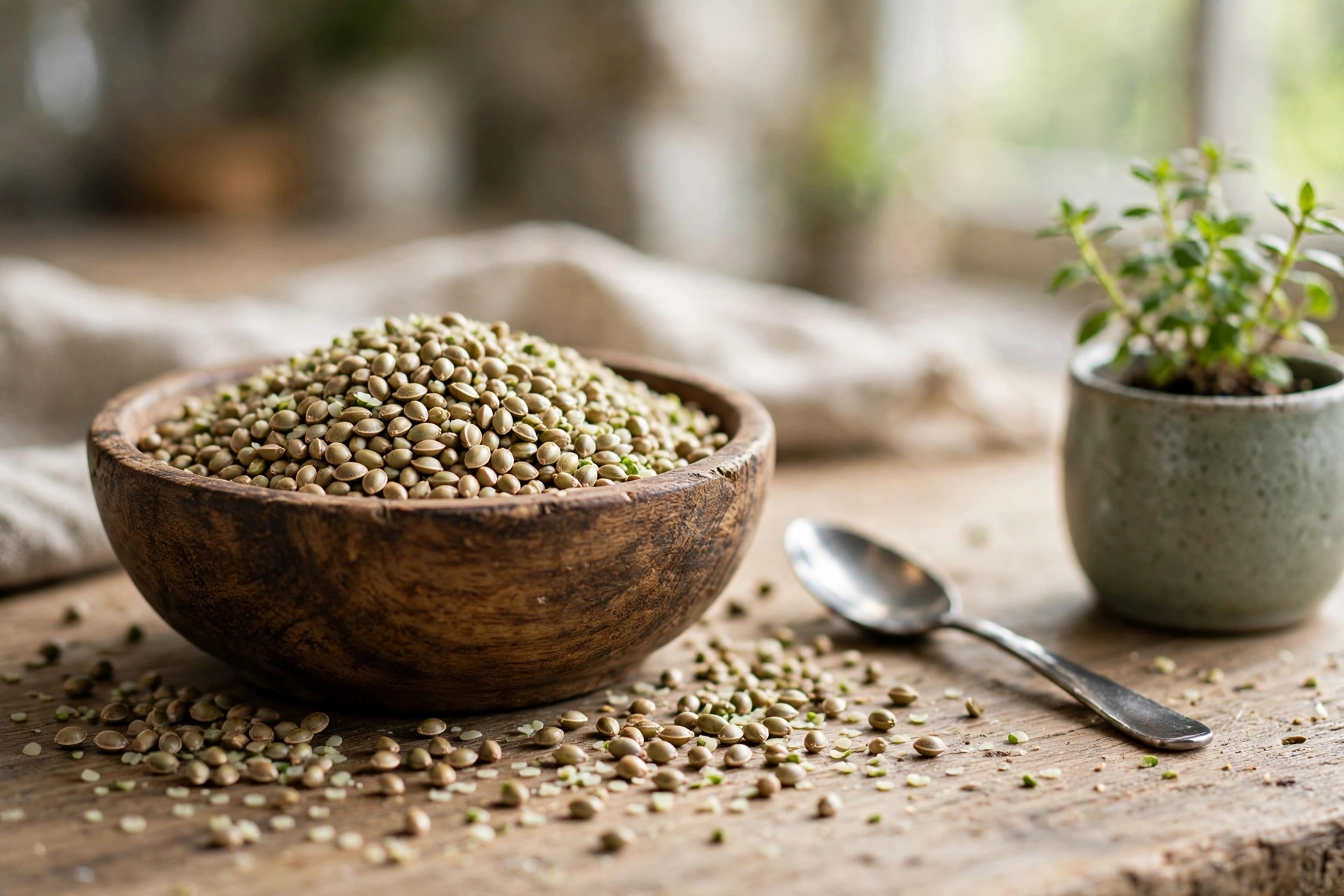
Hemp seeds are the small, nutty seeds of Cannabis sativa — the same plant species as marijuana, bred for fibre and food rather than for THC. The soft, hulled kernels sold as “hemp hearts” are the seed with the crunchy outer shell removed, and they are what you will find in most shops. Whole, unhulled seeds are crunchier and higher in fibre.
The first thing to clear up is the name problem. “Hemp” on a packet does not mean “cannabis drug” any more than “poppy seed” on a bagel means opium. Food-grade hemp seeds contain only trace amounts of THC — far too little to feel anything — and the U.S. Food and Drug Administration has said they cannot make the people who eat them high. Our hemp 101 guide explains how the same plant can be a rope, a salad topping, and a controlled substance, depending on which part you use and how it is grown.
What is actually in three tablespoons?
The numbers below are for three tablespoons — about 30 grams — of hulled hemp seeds, the serving size most packets use, calculated from USDA FoodData Central values, and WebMD’s hemp seeds guide lists the same serving at 166 calories and 10 grams of protein:
About 166 calories, about 9 to 10 grams of protein, about 15 grams of fat, and only about 1 gram of sugar. On the mineral side, the same serving brings roughly half a day’s magnesium (about 210 mg), nearly all of your manganese, about half your copper, and about 40% of your phosphorus. The fat is the interesting part: about 8.2 grams of linoleic acid, an omega-6, and about 2.6 grams of alpha-linolenic acid (ALA), the plant form of omega-3.
That 8.2 to 2.6 split is where the often-quoted 3-to-1 ratio comes from: roughly three parts omega-6 to one part omega-3. It is a genuine feature — but not a health claim, and no seed can fix a diet alone.
Complete protein — what does that actually mean?
Hemp seeds contain all nine essential amino acids, the ones your body cannot make and has to get from food. That makes them a complete protein, a club with surprisingly few plant members — soy and quinoa are the usual others. Most plant foods are missing one or two amino acids, which is why vegetarians are told to mix and match; hemp seeds do not need a partner.
Two honest caveats belong here. First, lysine — one of the nine — is the amino acid in shortest supply in hemp, so the protein quality score is good rather than perfect, roughly 63% to 66% on the standard PDCAAS scale. Second, “complete” describes the amino-acid profile, not the amount: three tablespoons give you about 10 grams of protein, a solid contribution to a meal, not a whole day’s worth. Think of them as a protein booster for porridge or a salad, not a main course.
The omega-3s: good, but not fish oil
Hemp seeds are one of the better plant sources of omega-3, and three tablespoons give you more ALA than the daily adequate intake for most adults. What they do not give you is EPA or DHA, the long-chain omega-3s found in oily fish — and your body converts only a small fraction of plant ALA into EPA and DHA, with the conversion to DHA being especially low.
That matters because most of the famous omega-3 research — the heart and brain studies people quote — is about EPA and DHA, not ALA. Hemp seeds are a useful source of plant omega-3, but they are not a substitute for fish — anyone selling them as one is overselling.
Hemp seeds also contain small amounts of two less common fats, gamma-linolenic acid (GLA) and stearidonic acid. GLA is rare in food and has been studied, with mixed results, for skin and joint inflammation — interesting, but far from proven, and present in hemp seeds only in small amounts.
Magnesium, manganese, and the quiet minerals
If hemp seeds have a headline mineral, it is magnesium: half a day’s worth in three tablespoons, in a nutrient most people do not get enough of from food alone. Magnesium helps regulate heartbeat and muscle function, and it is the mineral people are most likely to be short of. Manganese is the quiet overachiever — nearly a full day’s worth in the same serving — alongside meaningful copper, phosphorus, iron, and zinc, plus vitamin E and B vitamins.
None of this makes hemp seeds a medicine. It makes them a nutrient-dense food, the same way lentils or pumpkin seeds are. The difference between a food and a supplement is that a food earns its place by what it adds to a meal, not by what it claims to treat — and hemp seeds earn theirs.
Hemp seeds are not CBD oil — do not mix them up
This is the confusion that costs people money. Hemp seeds and CBD oil come from different parts of the plant, are made differently, and do different things — or, in the case of the seeds, deliberately do nothing at all beyond feeding you.
CBD oil is extracted from the flowers and leaves, where the cannabinoids live. Hemp seeds come from the seeds, which contain virtually no cannabinoids. Hemp seed oil — pressed from the seeds — is a cooking oil with the same fatty-acid profile as the seeds themselves, and it is not CBD oil either, no matter what a label implies. Our guide to CBD oil vs hemp oil walks through the label tricks, and our guide to the difference between hemp seed oil and CBD covers the same ground from the shopping angle.
The practical test is simple: if a product promises calm, sleep, or pain relief, it is selling you cannabinoids, not seeds. If it lists protein, magnesium, and omega-3s, it is selling you food. Both can be fine products — but they are not the same product, and they should not share a price tag. For the plant-level picture, our guide comparing hemp and marijuana explains where the legal and chemical lines actually sit.
Are hemp seeds safe, and who should be careful?
For most people, yes. In 2018, the FDA reviewed hulled hemp seed, hemp seed protein powder, and hemp seed oil and had no questions about their status as generally recognized as safe (GRAS) for use in food — the formal way of saying qualified experts consider them safe for their intended use. They are a whole food with no known toxicity at culinary servings.
Two groups should still pause. Hemp seed allergy exists, though it is uncommon — if you are allergic to other seeds or nuts, introduce hemp seeds cautiously and watch for a reaction. And people with kidney disease who follow a phosphorus limit should count hemp seeds like any other phosphorus-rich food and check with their doctor, since three tablespoons carry a meaningful share of the day’s phosphorus.
One more practical note: hulled hemp hearts are low in fibre — about 1.2 grams per serving — because the fibre lives mostly in the shell that was removed. If you want the fibre, buy whole, unhulled seeds instead. And store them like any oily seed: cool, dark, and sealed, because the same unsaturated fats that make them nutritious also make them go rancid faster than a bag of rice.
How to actually eat them
The easiest way is the laziest: sprinkle three tablespoons over porridge, yoghurt, or a salad, or blend them into a smoothie. They taste mild and nutty, a little like sunflower seeds, and they disappear into food rather than dominating it. Toasted, they add crunch to stir-fries and roasted vegetables; ground, they thicken sauces and baking.
There is no magic time of day and no ritual required. The people who get the most from hemp seeds are the ones who treat them as a pantry staple — the same shelf as the oats and the olive oil — rather than a supplement with a ceremony. Two to three tablespoons a day is the usual serving, and it is plenty: more is not better, it is just more calories.
Frequently asked questions
Will hemp seeds get me high?
No. Food-grade hemp seeds contain only trace amounts of THC, far too little to feel any effect, and the FDA has said they cannot make people high. They are food, not a drug — the cannabinoids live in the plant’s flowers and leaves, not in its seeds.
Are hemp seeds a complete protein?
Yes. Hemp seeds contain all nine essential amino acids, putting them in a small club of plant complete proteins alongside soy and quinoa. Three tablespoons give you about 9 to 10 grams of protein — a solid boost to a meal, though lysine is in shortest supply.
What is the omega-3 to omega-6 ratio in hemp seeds?
About 3 to 1, omega-6 to omega-3 — roughly 8.2 grams of linoleic acid to 2.6 grams of ALA per three-tablespoon serving. That is far lower than the typical Western diet, which often exceeds 15 to 1, but the omega-3 is ALA, not the EPA and DHA found in fish.
Are hemp seeds the same as CBD oil?
No, and the mix-up costs people money. CBD oil is extracted from the flowers and leaves, where cannabinoids live. Hemp seeds come from the seeds, which contain virtually no cannabinoids, and hemp seed oil is a cooking oil — not CBD oil, whatever the label implies.
How much magnesium is in hemp seeds?
About 210 mg per three tablespoons, roughly half the daily value for most adults. The same serving also brings nearly all of your manganese, about half your copper, and 40% of your phosphorus — which is why people with a kidney-related phosphorus limit should check with a doctor.
This article is general information about a food, not medical advice. If you have a seed allergy or kidney disease, or you take medicines affected by diet, talk to your doctor before changing what you eat. See our medical disclaimer.
For a broader overview of cannabis basics on this site, see our cannabis basics and wellness hub.
Affiliate Disclosure
The CakeHeights Editorial Team is committed to providing accurate, research-backed information about cannabis and hemp products. Some links on this page are affiliate links, meaning we may earn a commission at no extra cost to you if you make a purchase through them. Our recommendations are based on independent research, testing, and analysis. We only promote products we believe offer genuine value to our readers. Learn more →

Related Articles
 Cannabis Basics & Wellness
Why You Keep Waking Up at 3 a.m. — and What Actually Helps You Fall Back Asleep
 Cannabis Basics & Wellness
Set and Setting: Why Your Mindset and Surroundings Change Your High
 Cannabis Basics & Wellness