
Table of Contents
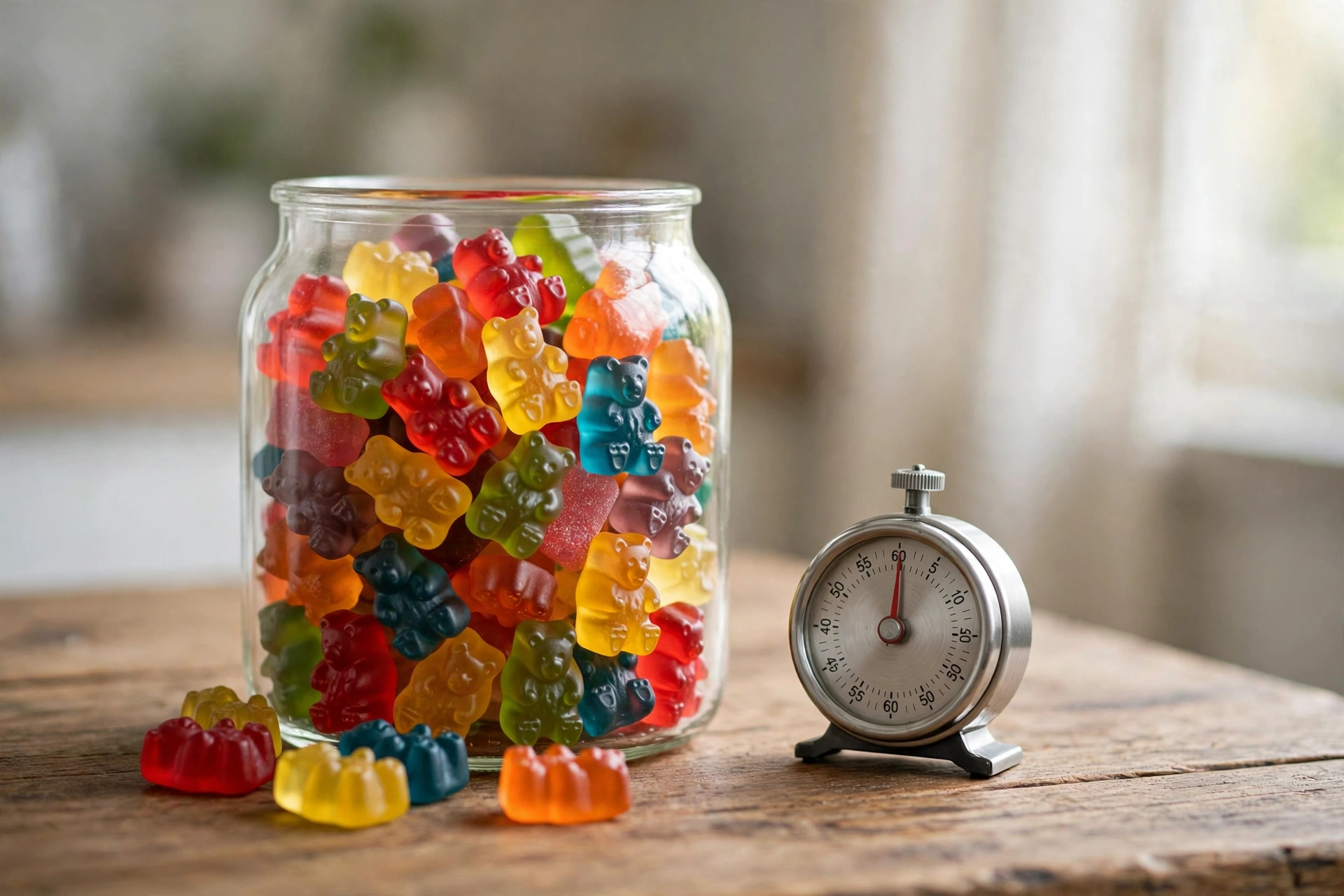
Most edibles take 30 minutes to 2 hours to kick in, and the first sign is usually a slow shift rather than a sudden switch. You may notice your body relaxing, food tasting richer, or time feeling stretched. If nothing has changed after an hour, that is still normal — waiting beats taking more.
Edibles are the slow lane of cannabis. When you smoke or vape, THC reaches your brain in minutes, but an eaten gummy has to travel through your stomach and intestines first. That delay is why people sit at the 45-minute mark wondering whether anything is happening.
This guide is about reading those early signals — what real onset feels like, how to tell it apart from anticipation, and what to do while you wait. If an edible did nothing at all, our guide to why your edible may not have worked covers the failure reasons.
How Long Do Edibles Usually Take to Kick In?
Most public-health sources give a range of 30 minutes to 2 hours. The Centers for Disease Control and Prevention (CDC) states edibles can take that long to produce intoxicating effects, and that effects may last longer than expected depending on amount, food, and medications or alcohol used.
That range is wide because bodies differ, and so do edibles — a gummy on an empty stomach may show up sooner than a brownie after a big dinner.
| Time after eating | What may happen |
|---|---|
| 0–30 minutes | Usually nothing yet — still being digested. |
| 30 minutes–2 hours | Onset. First subtle signs may appear. |
| About 1.5–3 hours | Peak. Strongest effects in controlled studies. |
| 4–8 hours | Effects fade gradually; some feel lingering sleepiness. |
The peak numbers come from lab work. In a 2017 study, researchers gave healthy adults brownies with 10, 25, or 50 mg of THC and found subjective effects peaked 1.5 to 3 hours after eating and lasted 6 to 8 hours, with stronger effects at higher doses. A later Johns Hopkins study found blood levels of THC and its active metabolite peaking around 1.5 to 2 hours, then declining to baseline by about eight hours.
One more number: the National Institute on Drug Abuse (NIDA) defines a standard THC unit for research as 5 mg — a measuring stick for studies, not a recommendation. For how that compares with common labels, see our THC dosage chart.
What Are the First Signs an Edible Is Working?
Onset rarely announces itself with a bang — more often it is a creeping change. Here are the early signs most often reported, drawn from how NIDA describes cannabis effects:
- A loosening body — shoulders drop and you may feel pleasantly heavy or warm.
- Sharper senses — music sounds richer and food tastes better.
- Time stretching. Minutes feel longer than usual.
- A dry mouth, which can show up before the stronger feelings do.
- Hunger — increased appetite may arrive while the rest is still building.
- Wandering thoughts. It gets harder to follow a train of thought.
- Mood shifting. Many people feel euphoric and giggly; some feel anxious instead, especially at higher amounts.
A useful test: try reading a paragraph. If it suddenly takes more effort, or you keep re-reading the same line, that is a better clue than staring at the clock asking, “Do I feel it yet?” Edibles often feel more body-focused than smoking, so heavy limbs or a warm glow while your mind still feels clear can mean onset is underway.
Is It Kicking In, or Am I Just Expecting It To?
Research says expectation plays a real part. In a 1998 study of oral THC, regular users who expected a cannabinoid reported greater pleasurable effects than those who did not — even at the same dose (see the study on PubMed). That does not mean the feeling is fake: the edible supplies the THC and your brain supplies the context. But a flutter of excitement 15 minutes after eating is more likely anticipation than onset — the NIDA research report on marijuana notes effects from foods or drinks are usually delayed by at least 30 minutes.
How do you tell the difference? Timing: anything before 30 minutes is very unlikely to be the edible itself. Persistence: anticipation spikes and fades, while real onset builds slowly and stays. Specificity: a vague buzz could be anything, but dry mouth plus heavy limbs plus stretched time is a pattern. Distraction test: do something absorbing for 20 minutes — if the feeling is still there when you come back, that points toward real onset.
If you are unsure, assume it has not fully kicked in yet and keep waiting — an extra hour costs boredom, while deciding too early can mean a second dose on top of the first.
Why Does Onset Feel Different Every Time?
Even with the same product, onset can shift day to day. An edible eaten on an empty stomach is generally absorbed faster than one eaten after a full meal, and a larger amount usually peaks higher and lasts longer, though it does not always kick in faster. Labels are not always accurate either, which the CDC flags as a real problem with edibles.
Your own body matters most: metabolism, tolerance, sleep, stress, and medications can shift timing. Two people can eat the same gummy and feel it an hour apart, and both are normal.
There is one more layer: after you swallow THC, your liver converts much of it into 11-hydroxy-THC, an active metabolite that helps explain why edibles feel stronger and last longer. That conversion takes time, and it is a big reason onset is slow. The full mechanics are covered in our guide to why your edible may not have worked.
What to Do While You’re Waiting
The waiting period is where most mistakes happen. The one rule that matters most: do not redose early. New York State’s cannabis guidance advises waiting up to 2 hours before eating more, because it can take that long to feel the full effects. A second serving at the one-hour mark may peak together with the first — and that is how a mild evening turns overwhelming.
Set a timer. Note the time you ate, the product, and the amount on the label, then set a timer for two hours and do something else. For the full timeline after onset, our guide to how long the effects of edibles last walks through the peak and the fade.
Stay somewhere comfortable — home, or somewhere safe and familiar, for the next several hours. Do not drive or take on tasks needing full coordination — cannabis can impair driving, and edibles make that harder to predict because of the delayed onset. A light snack and water can help, and skip alcohol while you wait: the CDC notes alcohol can change how long and how strongly edibles affect you. Keep the packaging — if you feel unwell later, the label and the time you ate are useful information.
When Do Edibles Peak, and When Do They Fade?
Once onset begins, effects usually keep building. In the brownie study, subjective effects peaked around 1.5 to 3 hours after eating; other sources put the peak around 2 to 4 hours, especially at higher amounts. The peak is not the moment you first feel something — it is the strongest point, and it arrives well after the first signs.
The peak lasts an hour or two, then the experience fades gradually. Most noticeable effects are gone within 6 to 8 hours, but public-health sources note effects can last up to about 12 hours, with lingering sleepiness the next morning. Do not assume you are clear to drive just because the strongest part has passed.
What If It Feels Too Strong?
Sometimes onset arrives all at once and feels stronger than expected. Uncomfortable, but for most healthy adults it passes as the THC clears. Stay where you are, lie down if you feel dizzy, sip water, and remind yourself the feeling is temporary. A calm, sober friend nearby helps.
Get medical help promptly for chest pain, trouble breathing, a racing heartbeat that does not settle, severe confusion, or if you cannot stay awake — or if a child has eaten an edible. In the US, call Poison Control at 1-800-222-1222, or 911 in an emergency.
If the edible never kicked in, do not try to beat it next time with a much bigger amount. Storage, labeling, tolerance, and metabolism all play a part — our guide to how to store CBD gummies covers keeping gummies fresh and potent, which applies to THC gummies too.
This article is general information, not medical advice. If you have a health condition, take medication, or are unsure whether cannabis is safe for you, talk to your doctor first — see our Medical Disclaimer.
The THC & Cannabinoids hub gathers our guides on THC, dosing, and edible effects in one place.
Frequently Asked Questions
How long does it take for an edible to kick in?
Most edibles take 30 minutes to 2 hours to kick in, according to the CDC. The first signs are usually subtle — relaxation, sharper senses, or stretched time — and the peak often arrives later, around 1.5 to 3 hours after eating. Nothing after an hour is still normal, so keep waiting.
What does it feel like when an edible starts working?
Onset usually feels like a slow shift rather than a sudden change. Common early signs include a loosening body, richer music or food, a dry mouth, hunger, and time feeling longer than usual. If several show up together and keep building, that pattern points to real onset.
Can you feel an edible in 15 minutes?
It is very unlikely. THC from a swallowed edible must pass through digestion and the liver before it reaches the brain, and NIDA notes effects from foods or drinks are usually delayed by at least 30 minutes. A flutter at 15 minutes is more likely anticipation than the edible itself, so do not take more based on it.
Should I take another edible if I don’t feel anything after an hour?
No — wait at least 2 hours before considering more. Public-health guidance, including New York State’s, advises waiting up to 2 hours because the full effects can take that long to arrive. A second serving eaten too early may peak with the first one, making the experience much stronger than planned.
How long do edibles last once they kick in?
In controlled studies, an edible’s effects typically lasted 6 to 8 hours, with the peak around 1.5 to 3 hours after eating. Public-health sources note effects can last up to about 12 hours, with lingering sleepiness the next morning, especially after a larger amount.
Affiliate Disclosure
The CakeHeights Editorial Team is committed to providing accurate, research-backed information about cannabis and hemp products. Some links on this page are affiliate links, meaning we may earn a commission at no extra cost to you if you make a purchase through them. Our recommendations are based on independent research, testing, and analysis. We only promote products we believe offer genuine value to our readers. Learn more →

Related Articles
 THC & Cannabinoids
What Is Farnesene? The Green-Apple Terpene, Explained
 THC & Cannabinoids
Low-Dose Edibles: A Beginner’s Guide to Microdosing
 THC & Cannabinoids