
Table of Contents
The endocannabinoid system (ECS) is a cell-signaling network found throughout the body — in the brain, immune system, gut, and peripheral organs — that helps regulate pain, mood, appetite, memory, and immune response. It has three parts: endocannabinoids the body makes itself, the receptors they bind to, and the enzymes that break them down. Cannabis compounds work by interacting with this system. The science is real and well-established at the mechanism level; the therapeutic claims built on it are mostly early-stage, and this guide keeps those two things separate.
The three components
Endocannabinoids
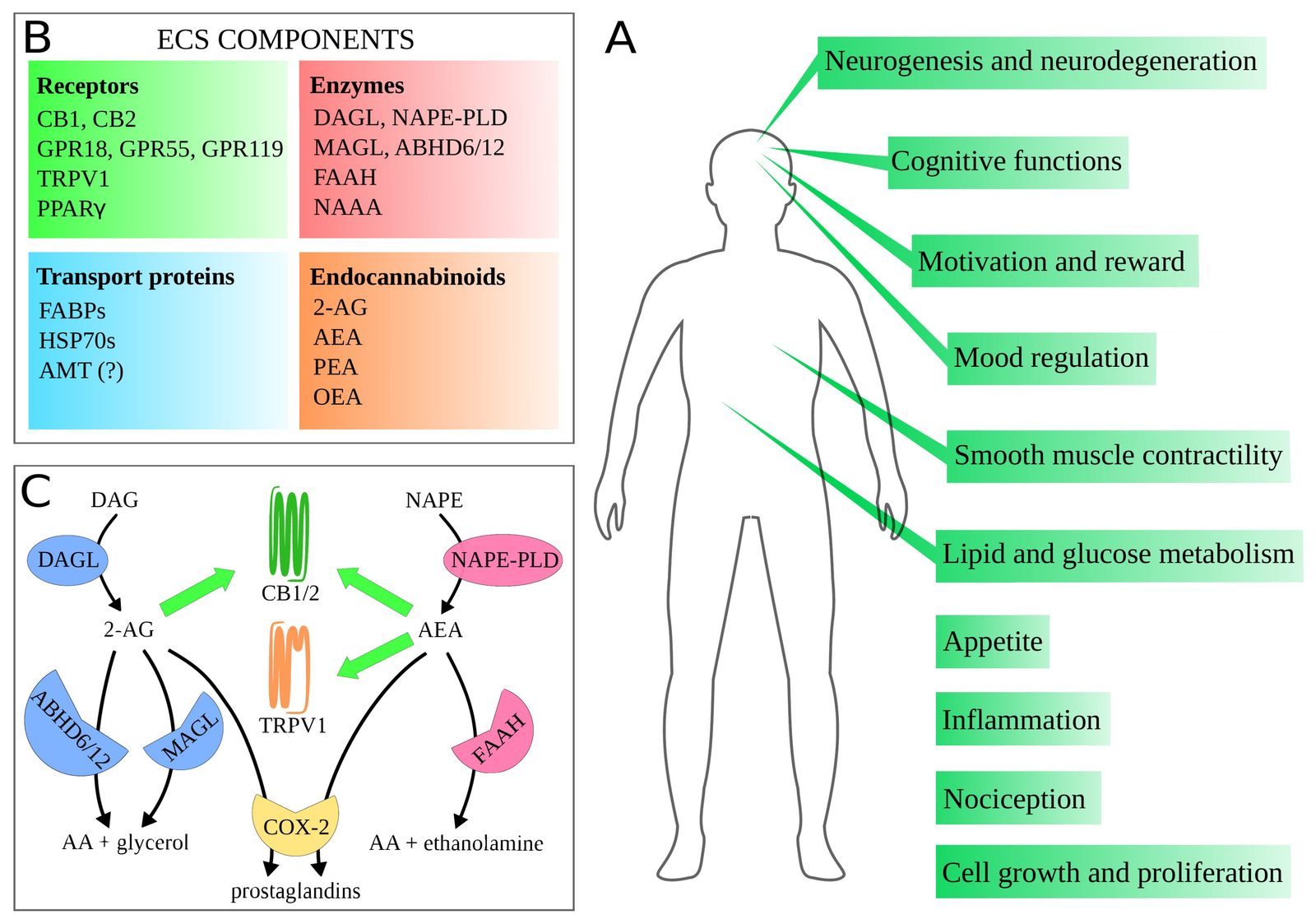
The two best-studied are anandamide (AEA) and 2-arachidonoylglycerol (2-AG). Unlike most neurotransmitters, they are made on demand — synthesized when needed, not stored — and act locally before being broken down.
Receptors: CB1 and CB2
CB1 receptors are concentrated in the brain and central nervous system (with some in peripheral tissues). THC binds strongly to CB1 — that binding is what produces the high. CB2 receptors are found mainly in immune cells and peripheral tissues, and are more associated with immune and inflammatory responses. CBD binds weakly to both; its effects are thought to work through other pathways and by modulating how the system behaves, not by direct CB1 activation.
Enzymes: FAAH and MAGL
FAAH breaks down anandamide; MAGL breaks down 2-AG. These enzymes end the signal. Much drug-development research targets them — blocking FAAH, for example, raises anandamide levels — but no FAAH/MAGL inhibitor is an approved medicine today.
What the system regulates
The ECS is a modulator, not a master switch: it fine-tunes other systems rather than driving them directly. Its established roles include:
- Pain signaling: endocannabinoids dampen pain signals at multiple levels of the nervous system. This is the mechanistic basis for the modest evidence of cannabis/cannabinoids for chronic pain noted by the NCCIH.
- Mood and stress: the ECS interacts with stress-response circuits, including the HPA axis. Dysregulation is associated with anxiety and depression in research — association, not proof that “boosting” the ECS treats them.
- Memory and learning: CB1 receptors are dense in the hippocampus; THC’s memory effects (short-term impairment) are a direct consequence. Claims that targeting the ECS “enhances memory” or treats Alzheimer’s disease are preclinical — animal and cell studies, not human evidence.
- Appetite and metabolism: CB1 activation increases appetite (the mechanism behind THC’s appetite stimulation and behind the approved drug dronabinol).
- Immune function: CB2 signaling modulates immune cell activity. Claims about inflammatory bowel disease and other immune conditions are early-stage.
What is — and is not — established
Established: the components, the receptors, the basic signaling, and the fact that THC’s psychoactive effects run through CB1. Early-stage: nearly every therapeutic application — pain, anxiety, PTSD, neurodegeneration, IBD, sleep. The NASEM evidence-review method is the right model here: grade each claim by its evidence, and do not promote a preclinical finding into a treatment. The FDA has not approved the cannabis plant for any medical use; the approved cannabinoid medicines are specific purified or synthetic products for specific indications.
Can you “support” your endocannabinoid system?
Exercise, sleep, and stress management are associated with healthy ECS function in research — but so are they with every other system in the body, and no lifestyle intervention is proven to “optimize” the ECS specifically. CBD products are not approved as ECS-support supplements, and the evidence for CBD’s effects on the ECS in humans is early-stage. Be skeptical of any product claiming to “balance” or “restore” your endocannabinoid system.
Frequently asked questions
What is the endocannabinoid system?
A cell-signaling network of endocannabinoids, CB1/CB2 receptors, and breakdown enzymes that modulates pain, mood, appetite, memory, and immune response.
How does the endocannabinoid system work?
Endocannabinoids (anandamide, 2-AG) are made on demand, bind to CB1/CB2 receptors to modulate signaling, and are broken down by FAAH and MAGL enzymes.
Does THC work through the endocannabinoid system?
Yes — THC binds strongly to CB1 receptors in the brain, which produces its psychoactive effects. See our THC psychoactive effects guide and our THC classification guide.
Can the endocannabinoid system be used to treat disease?
It is a research target, not an established treatment pathway. Approved cannabinoid medicines exist for specific indications (seizures, chemo nausea, appetite), but most ECS-targeted claims are preclinical.
How can I support my endocannabinoid system?
General health measures — exercise, sleep, stress management — are associated with healthy function. No product is proven to “balance” the ECS, and CBD is not approved for that purpose.
For the cannabinoid comparisons, see our CBD vs THC guide and our THC benefits and side effects guide, and browse the THC & Cannabinoids hub.
Affiliate Disclosure
The CakeHeights Editorial Team is committed to providing accurate, research-backed information about cannabis and hemp products. Some links on this page are affiliate links, meaning we may earn a commission at no extra cost to you if you make a purchase through them. Our recommendations are based on independent research, testing, and analysis. We only promote products we believe offer genuine value to our readers. Learn more →

Related Articles
 THC & Cannabinoids
Is Delta-8 Safe? A Balanced Look at the Safety Data
 THC & Cannabinoids
THC % to mg: How to Work Out How Strong Your Edible Really Is
 THC & Cannabinoids
Leave a Reply