
Table of Contents
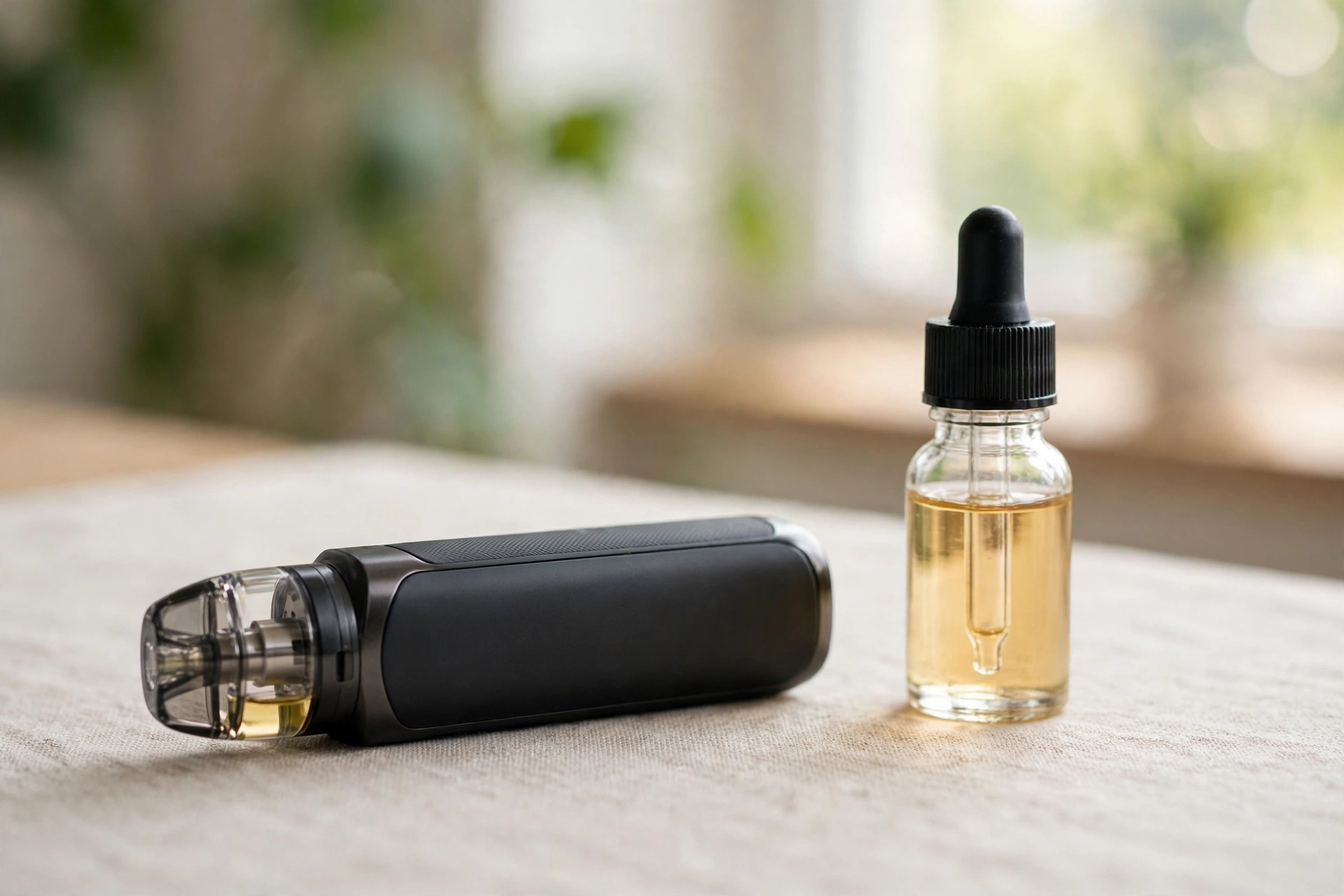
No — never vape standard CBD oil. The tincture in the dropper bottle is made to swallow, and its carrier oils (usually MCT or hemp seed oil) do not belong in your lungs. Only liquids made specifically for vaping, built on propylene glycol and vegetable glycerin, should ever go in a vape.
Two products, one confusing name
The confusion starts on the shelf. Both bottles say “CBD oil,” both are small, and both often come with a dropper — but they are built for entirely different jobs.
A CBD tincture is food, more or less. It is CBD extract suspended in a carrier oil, usually MCT (medium-chain triglyceride) oil or hemp seed oil, and it is made to be swallowed or held under the tongue. The oil is the delivery vehicle: it carries the CBD through your digestive system.
A CBD vape liquid is a different recipe. It is CBD dissolved in propylene glycol (PG) and vegetable glycerin (VG) — the same base used in ordinary e-liquid — with no oil in it at all. When heated, PG and VG turn into a vapour your lungs are built to handle. Oil does not.
The labels are supposed to make this obvious, and usually they do if you read them: a tincture says “take orally” or “place under the tongue,” while a vape liquid says “for vaping” or “e-liquid.” The danger is the bottle that says neither clearly, or the friend who tells you “it’s all the same stuff.” It is not.
Why vaping oil hurts your lungs
Your lungs are built for air, not fat. When oil droplets reach the tiny air sacs deep in your lungs — the alveoli, where oxygen crosses into your blood — the immune cells there try to clear them and largely cannot. The oil sits, the cells swell with trapped fat, and the result is inflammation that can scar the tissue and make breathing harder.
Doctors call this exogenous lipoid pneumonia: “lipoid” because it is caused by lipids (fats), “pneumonia” because it inflames the lungs. It is rare, but it is real, and case reports have linked it to vaping cannabis oils. The symptoms — a cough that will not quit, shortness of breath, chest discomfort — can creep up over weeks, which makes it easy to miss until it is serious. Unlike a burnt coil, which announces itself with a horrible taste, oil in your lungs gives no warning at the time.
There is a nuance worth stating honestly: pure, winterized cannabis extract contains very little actual fat, and experts note that the lipoid pneumonia risk comes mainly from the carrier oils and cutting agents, not from CBD itself. That does not make vaping tincture safe — MCT and hemp seed oil are exactly the lipids in question, and they are the first two ingredients in most tinctures. The CBD is innocent; the bottle it swims in is the problem.
What EVALI taught us
The clearest warning comes from the 2019–2020 outbreak of vaping-related lung injury, known as EVALI. As of 18 February 2020, the U.S. Centers for Disease Control and Prevention (CDC) had recorded 2,807 hospitalized EVALI cases and 68 deaths across the United States.
Investigators traced the outbreak largely to vitamin E acetate, a thick, oily additive used to dilute illicit THC vape cartridges. CDC laboratory analysis found vitamin E acetate in the lung fluid of 48 out of 51 EVALI patients — and in none of the 99 people in the comparison group. The finding was published in the New England Journal of Medicine by Blount and colleagues, and the CDC’s own summary puts it bluntly: vitamin E acetate is strongly linked to the outbreak, and it has not been found in the lung fluid of people without EVALI.
EVALI was mostly about black-market THC cartridges, not CBD tinctures, and it would be wrong to pretend otherwise. But the lesson carries over cleanly: the lungs cannot cope with inhaled oils, and unregulated vape products are exactly where oily cutting agents turn up. Every rule in this article follows from that one fact.
How to tell what you are holding
Before anything goes into a vape, check three things on the label. First, the words: it should say “vape,” “e-liquid,” or “for vaping” — if it says “tincture,” “oral,” or “place under the tongue,” it is not for your device. Second, the ingredients: a vape liquid lists propylene glycol and vegetable glycerin; a tincture lists MCT oil, hemp seed oil, or olive oil. Third, the seller: buy from a brand that publishes a third-party lab report for the exact batch, and check it the way our guide to how to read a CBD lab report explains.
If any of those three checks fails — the label is vague, the ingredients list an oil, or there is no lab report — do not vape it. A bottle that cannot prove what it is has no business in your lungs. And if a vape pen is giving you trouble for other reasons, our guide to why your disposable vape is blinking covers the common hardware faults that look like liquid problems but are not.
If you do want to vape CBD, do it this way
First, buy a liquid made for vaping, from a reputable brand, with a lab report — and read the report. Second, check the ingredients for vitamin E acetate and for any oil; neither belongs in a vape liquid. Third, start with a device you understand: a simple vape pen or pod, not a high-powered mod. Our guide to how to use a vape pen walks through the basics if you are new to the hardware.
Fourth, pay attention to your body. A persistent cough, wheeze, chest tightness, or breathlessness after vaping is a reason to stop and see a doctor — promptly, not eventually. Vaping is not recommended for anyone with asthma, COPD, or any other lung condition, and nobody should vape a product bought from an informal seller or a market stall.
Finally, if vaping was never the point and you only want CBD itself, the simplest answer is to skip the vape entirely. Swallowing a tincture or eating a gummy is how CBD oil was designed to be used — and our guide to whether CBD vape pens help you sleep is a useful reality check on one of the most common reasons people reach for a vape in the first place.
Frequently asked questions
Can you vape regular CBD oil from a dropper bottle?
No, never. Dropper-bottle CBD oil is a tincture made to swallow, and its carrier oils — usually MCT or hemp seed oil — can cause lipoid pneumonia when inhaled. Only liquids labelled for vaping, built on propylene glycol and vegetable glycerin, belong in a vape device.
What is lipoid pneumonia?
It is inflammation of the lungs caused by inhaling fats or oils. Immune cells in the lung’s air sacs cannot break the oil down, so it builds up and triggers chronic inflammation. Symptoms include a persistent cough, shortness of breath, and chest discomfort, and it can cause lasting lung damage.
What caused the EVALI outbreak?
Vitamin E acetate, an oily thickener used in illicit THC vape cartridges, was strongly linked to the outbreak. The CDC recorded 2,807 hospitalized cases and 68 deaths as of 18 February 2020, and a New England Journal of Medicine study found vitamin E acetate in 48 of 51 patients’ lung fluid.
How can I tell a CBD vape liquid from a tincture?
Read the label: vape liquids say “for vaping” or “e-liquid” and list propylene glycol and vegetable glycerin, while tinctures say “take orally” and list a carrier oil such as MCT or hemp seed oil. A lab report for the exact batch is the final check.
Is vaping CBD safe if I use the right liquid?
Safer, not safe. A properly made vape liquid removes the oil problem, but vaping still carries risks — contaminated or unregulated products, unknown additives, and irritation for anyone with a lung condition. If you have asthma or COPD, do not vape, and see a doctor about any breathing symptoms.
This article is general information, not medical advice. Vaping carries health risks, and inhaling oils can cause serious lung injury. If you have breathing symptoms after vaping, stop and seek medical care promptly. See our medical disclaimer.
For a broader overview of vaping guides on this site, see our vaping and e-liquids hub.
Affiliate Disclosure
The CakeHeights Editorial Team is committed to providing accurate, research-backed information about cannabis and hemp products. Some links on this page are affiliate links, meaning we may earn a commission at no extra cost to you if you make a purchase through them. Our recommendations are based on independent research, testing, and analysis. We only promote products we believe offer genuine value to our readers. Learn more →

Related Articles
 Vaping & E-Liquids
MTL vs DTL Vaping: What’s the Difference?
 Vaping & E-Liquids
How to Quit Vaping: A Realistic Plan That Works
 Vaping & E-Liquids