

Table of Contents
Vaping means inhaling an aerosol produced by heating a liquid, called e-liquid or vape juice, in a battery-powered device. The aerosol usually contains nicotine, flavorings, propylene glycol (PG), and vegetable glycerin (VG). Vaping is not smoking: nothing burns, so there is no tar and no carbon monoxide. But it is not harmless either. The aerosol is not water vapor, nicotine is addictive, and the long-term effects of inhaling flavored aerosol for decades are still unknown. This guide explains how vaping works, what is in the aerosol, how devices differ, and what the rules are, without the hype from either side.
How does a vape work?
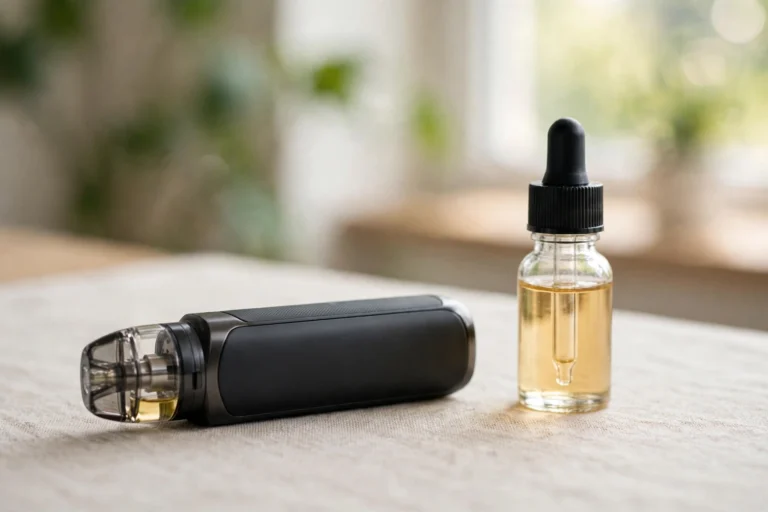
Every vaping device, from the smallest disposable to the largest box mod, works the same way. A battery sends power to a coil, a small heating element wrapped in cotton or another wicking material. The coil heats the e-liquid soaked into the wick until it becomes an aerosol, which the user inhales through a mouthpiece. The user controls the experience by choosing the device, the coil, the liquid, and (on adjustable devices) the power.
| Part | What it does | What to know |
|---|---|---|
| Battery | Powers the coil | Built-in in pods and disposables; replaceable 18650/21700 cells in larger mods |
| Coil / atomizer | Heats the liquid into aerosol | A consumable: replace when flavor turns burnt or weak; see how vape coils work |
| Tank or pod | Holds the e-liquid | Tanks are refillable and swappable; pods are usually specific to one device |
| E-liquid | PG, VG, flavorings, and usually nicotine | Ratio and nicotine strength must match the coil; see PG vs. VG explained |
| Mouthpiece | Where you inhale | Narrow tips suit mouth-to-lung draws; wide tips suit direct-to-lung |
What is in the aerosol?
The aerosol is a suspension of tiny liquid droplets in air, not a gas and not steam. What it contains depends on the liquid, the device, and how hot the coil runs:
- Propylene glycol and vegetable glycerin, the base liquids. Both are approved for use in food, but neither has been approved for long-term inhalation, and PG can irritate airways and trigger allergies in some people.
- Nicotine, in most liquids, from 0 to 50 mg/ml depending on the product and the country. Nicotine is the addictive ingredient; it also raises heart rate and blood pressure.
- Flavorings, the least-studied part. Most flavor chemicals were tested for eating, not inhaling, and some (such as diacetyl, a buttery flavoring) are known to damage lungs at high inhaled doses.
- Breakdown products and metals. When liquid overheats, PG and VG can break down into formaldehyde and acetaldehyde. Heating coils can shed trace metals such as nickel, chromium, and lead into the aerosol. Levels are generally far below cigarette smoke, but they are not zero.
What is NOT in the aerosol matters too: no tar, no carbon monoxide, and none of the thousands of combustion chemicals in tobacco smoke. That absence is the entire basis for vaping being less harmful than smoking. It is not a basis for calling vaping safe.
What kinds of devices are there?
| Device | How it works | Who it suits |
|---|---|---|
| Disposable vape | Pre-filled, pre-charged, thrown away when empty | First-time triallers; banned in the UK since June 2025 and restricted in several other countries |
| Pod system | Small battery + refillable or prefilled pod, usually low power | Smokers switching: simple, discreet, works with nicotine salts; see our guide to pod systems |
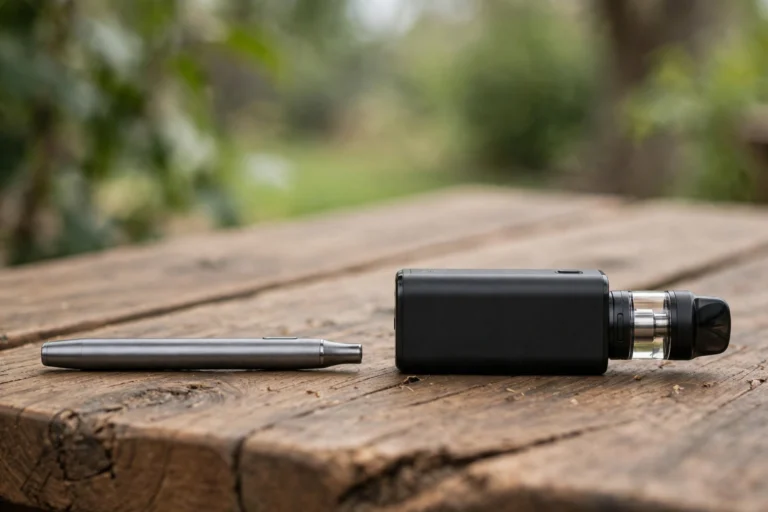
| Pen / starter kit | Slim battery + small tank | Beginners who want a refillable device without complexity |
| Box mod + tank | Larger adjustable device with a separate tank | Experienced users who want control over power and airflow; see box mods for beginners |
| Mechanical mod | Unregulated: battery wired straight to the coil, no chip, no protections | Experts only, and only with battery-safety knowledge; see what a mech mod is |
Is vaping safer than smoking?
Less harmful, yes; safe, no. The most quoted number comes from a 2015 Public Health England evidence review, which estimated e-cigarettes to be around 95% less harmful than smoking. That figure was an expert judgement based on the evidence available at the time, not a measurement from a clinical trial, and it has been contested ever since. Later UK government reviews have maintained the same overall position: vaping carries a small fraction of smoking’s risk, because there is no combustion. The U.S. CDC and FDA do not endorse the 95% figure.
The NHS vaping-to-quit guidance puts it plainly: nicotine vaping is less harmful than smoking, which makes it a reasonable quit aid for smokers, but it is not risk-free. England’s Chief Medical Officer summarized the official position in one sentence: if you smoke, vaping is much safer; if you do not smoke, do not vape. The full benefit only comes from switching completely: continuing to smoke while vaping removes most of the advantage. For the detailed comparison, see vaping vs. smoking.
What about secondhand aerosol?
Secondhand aerosol is real, and the original version of this post was wrong to say otherwise. Exhaled aerosol does dissipate faster than cigarette smoke, but the people around a vaper still breathe in part of it. The U.S. Surgeon General’s 2016 report concluded that secondhand e-cigarette emissions contain nicotine, ultrafine particles, flavorings such as diacetyl, volatile organic compounds such as benzene, and heavy metals such as nickel, tin, and lead, and warned that the emissions are not harmless. Levels are lower than secondhand smoke, but the honest rule is simple: do not vape around children, pregnant people, or anyone who has not chosen to breathe it in. The American Lung Association’s summary of the evidence covers the same findings.
What are the rules? (as of November 2026)
Regulation differs sharply by country, and it changes often. The key facts:
- United States: federal law (Tobacco 21) sets the purchase age at 21. There is no federal nicotine-strength cap, so U.S. liquids range up to 50 mg/ml or more. The FDA regulates e-cigarettes as tobacco products and has authorized only a small number of products for sale.
- United Kingdom and European Union: the Tobacco Products Directive caps nicotine at 20 mg/ml, refillable pods and tanks at 2 ml, and refill bottles at 10 ml, and bans diacetyl and several other flavor chemicals in e-liquids. The UK banned disposable vapes in June 2025 and applies a Vaping Products Duty from October 1, 2026.
- Canada: the Tobacco and Vaping Products Act caps nicotine at 20 mg/ml. Several countries, including Australia (prescription-only nicotine vaping) and Singapore (full ban), take much stricter approaches.
Wherever you are, the purchase age, the nicotine cap, and the flavor rules are local law, not universal fact. Check before you buy, and never buy from informal sellers: unregulated products are where the worst contamination problems have occurred.
Who should not vape?
Three groups should not vape at all. Young people: nicotine affects the developing brain, and youth vaping remains common enough to be a public health concern even as rates fall. Pregnant people: every major health body advises against all nicotine products during pregnancy, including e-cigarettes. Non-smokers: vaping offers no health benefit to someone who does not smoke, only new risks and a new addiction. If you smoke and want to quit, vaping is one option among several, alongside nicotine replacement therapy and prescription medications; a clinician or quitline can help you choose. If you do not smoke, the best choice is the simplest one: do not start.
Frequently asked questions
What is vaping?
Vaping is inhaling an aerosol made by heating e-liquid in a battery-powered device. The liquid usually contains nicotine, flavorings, propylene glycol, and vegetable glycerin. Nothing burns, so there is no tar or carbon monoxide, but the aerosol is not water vapor and is not harmless.
Is vaping safe?
No. Vaping is less harmful than smoking, because there is no combustion, but it carries real risks: nicotine addiction, airway irritation, and unknown long-term effects. UK health authorities estimate it carries a small fraction of smoking’s risk; U.S. authorities do not endorse a specific number.
What are the benefits of vaping?
For a smoker, the main benefit is harm reduction: switching completely to vaping removes exposure to tar, carbon monoxide, and most of the toxicants in smoke. For a non-smoker, there are no health benefits. Vaping is a quit aid and a harm-reduction tool, not a wellness product.
How does vaping work?
A battery powers a coil, which heats e-liquid soaked into a wick until it becomes an aerosol. The user inhales the aerosol through a mouthpiece. Adjustable devices let the user change power and airflow; simple devices do not.
Does vaping produce secondhand smoke?
It produces secondhand aerosol, not smoke. The aerosol contains nicotine, ultrafine particles, volatile organic compounds, and trace metals at lower levels than cigarette smoke, but the Surgeon General has warned it is not harmless. Avoid vaping around children and non-vapers.
Browse more in the Vaping & E-Liquids hub, including compact mods and pod systems for smaller devices.
Affiliate Disclosure
The CakeHeights Editorial Team is committed to providing accurate, research-backed information about cannabis and hemp products. Some links on this page are affiliate links, meaning we may earn a commission at no extra cost to you if you make a purchase through them. Our recommendations are based on independent research, testing, and analysis. We only promote products we believe offer genuine value to our readers. Learn more →

Related Articles
 Vaping & E-Liquids
MTL vs DTL Vaping: What’s the Difference?
 Vaping & E-Liquids
How to Quit Vaping: A Realistic Plan That Works
 Vaping & E-Liquids
Leave a Reply